

How Ballistic Gel Helps Demonstrate Energy Transfer
Introduction
Ballistic gel is useful because it makes impact behaviour easier to see.
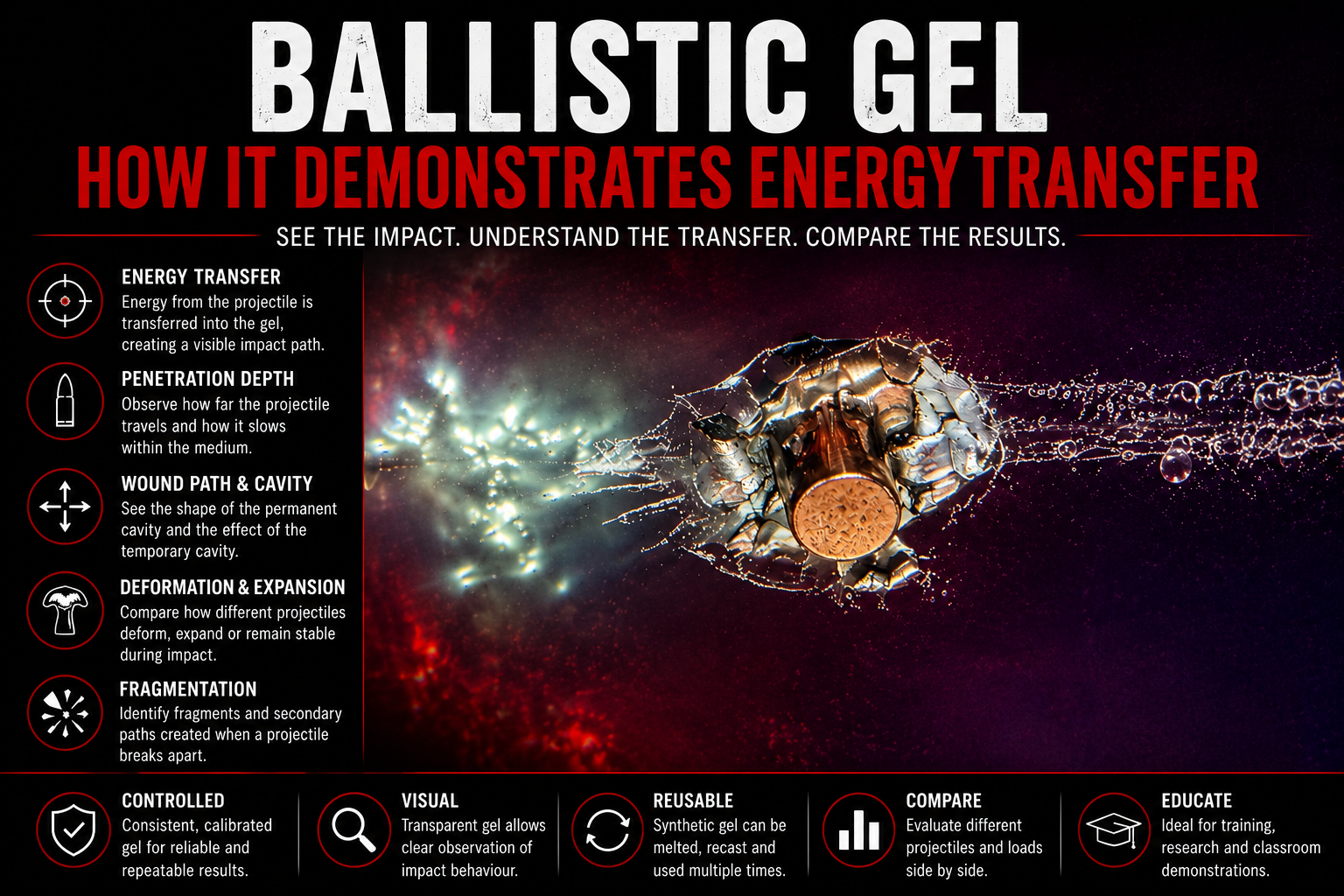
When a projectile, fragment or test object enters ballistic gel, it does not simply pass through without effect. It interacts with the material, creating a visible path and showing how energy is transferred into the surrounding medium.
This is one of the reasons ballistic gel is used for testing, demonstrations, research, training and education. It gives users a visual way to understand impact behaviour, penetration, deformation and energy transfer.
At Defensible Ballistics, we supply synthetic ballistic gel, natural ballistic gel, ballistic soap, gel chips and moulds for controlled testing and demonstration applications.
What is energy transfer?
Energy transfer describes how energy moves from one object into another.
In ballistic testing, this usually means how energy from a projectile is transferred into the testing medium when it impacts and travels through it.
As the projectile enters the gel, some of its energy is used to push the material aside, create a wound path, deform the projectile, generate movement in the surrounding gel and, in some cases, cause fragmentation or expansion.
The way energy is transferred can affect:
Penetration depth
Wound path shape
Temporary cavity behaviour
Projectile deformation
Projectile expansion
Fragmentation
Direction of travel
The visible result inside the gel
Ballistic gel helps make these effects easier to observe.
Why ballistic gel is useful for showing energy transfer
Ballistic gel provides a controlled soft-tissue simulant. Because the material is consistent, users can observe how different projectiles or test objects behave under similar conditions.
This makes ballistic gel useful for comparing how energy is transferred between different tests.
For example, one projectile may penetrate deeply with a narrow wound path. Another may deform quickly and transfer more energy earlier in the block. A third may fragment and create multiple paths.
Ballistic gel helps show these differences visually.
Penetration depth
Penetration depth is one of the most obvious results to observe in ballistic gel.
A projectile that retains more forward movement may travel deeper into the block. A projectile that expands, deforms or transfers energy more quickly may penetrate less deeply but create a wider or more disrupted path.
Penetration depth can help users compare:
Different projectile types
Different pellet or slug designs
Different impact speeds
Different test distances
Different gel densities
Different materials or barriers
For useful comparison, the test setup should remain as consistent as possible.
Wound path and cavity shape
As a projectile travels through ballistic gel, it leaves a visible wound path.
This path can help show how the projectile moved through the medium and how energy was transferred along the way. A narrow, straight path suggests a different type of behaviour from a wider, more disturbed path.
The cavity shape may show:
Where the projectile entered
Whether the projectile remained stable
Whether it tumbled
Whether it expanded
Where the most visible disruption occurred
How the surrounding material reacted
Synthetic ballistic gel is especially useful here because it is transparent, allowing users to inspect the path inside the block.
Temporary and permanent cavity
When a projectile passes through a soft medium, there may be both temporary and permanent cavity effects.
The temporary cavity is the movement or stretching of the surrounding material during impact.
The permanent cavity is the path or disruption left after the projectile has passed through.
Ballistic gel can help demonstrate both effects, depending on the type of gel, the test setup and how the result is recorded.
High-speed video may show temporary movement, while post-impact inspection can show the remaining path.
Projectile deformation and expansion
Energy transfer can also affect the projectile itself.
Some projectiles deform, expand or fragment when they enter the gel. This can change how energy is transferred into the medium.
A projectile that expands may slow more quickly and create a wider path. A projectile that remains stable may continue deeper into the block. A projectile that fragments may create multiple channels.
Ballistic gel helps users observe and compare these behaviours.
Fragmentation
Some projectiles or test objects may fragment during impact.
When fragmentation occurs, the gel may show separate paths where fragments travel away from the main wound channel. This can be useful for visual analysis and comparison testing.
Synthetic ballistic gel can be helpful because the transparent medium allows the user to see fragment paths inside the block before cutting or removing material.
Why consistency matters
Energy transfer testing is only useful if the comparison is fair.
If the gel type, density, block size, distance or test setup changes between tests, the results may be harder to interpret.
To improve consistency, users should try to keep the following the same:
Gel type
Gel density
Block size
Test distance
Projectile type or category
Test angle
Temperature and handling
Backstop and support
Recording method
Consistent testing helps make differences in results more meaningful.
Why Calibration Matters in Ballistic Gel Testing
10% vs 20% ballistic gel and energy transfer
Gel density affects how the test medium responds.
10% ballistic gel is softer and is commonly used for forensic/FBI-style testing, airgun testing, demonstrations and general comparison work.
20% ballistic gel is firmer and is commonly used for NATO-style testing or where a denser, more resistant medium is required.
A result in 10% gel should not be treated as identical to a result in 20% gel. The density of the medium affects penetration, resistance and the visible wound path.
10% vs 20% Ballistic Gel: What Is the Difference?
Synthetic ballistic gel for visual analysis
Synthetic ballistic gel is useful for demonstrating energy transfer because it is transparent and reusable.
The transparency allows users to see the path inside the block, which makes it easier to photograph, film and explain the result.
The reusability makes it practical for repeated demonstrations and comparison tests. After testing, synthetic gel can be melted, recast and used again when handled correctly.
Synthetic gel is useful when users need:
Clear visual inspection
Repeated demonstrations
Photography and video
Comparison testing
Calibrated density
Reusable material
Ready-made blocks or chips
Synthetic Ballistic Gel Information
Natural ballistic gel for traditional testing
Natural ballistic gel is a traditional gelatine-based testing medium.
It is supplied as powder and prepared by mixing with water, heating, pouring and setting. It can be useful where a traditional 10% gelatine-based medium is preferred.
Natural gel can be used for controlled demonstrations, but it requires careful preparation and handling to achieve consistent results.
Ballistic soap for preserved cavity analysis
Ballistic soap can also be useful when demonstrating energy transfer, especially when the aim is to preserve the cavity after impact.
Unlike gel, which may close back around the wound path, ballistic soap can hold the cavity shape more clearly. This makes it useful for post-impact inspection, photography and comparison work.
Ballistic gel is often better when transparency and reusability are important. Ballistic soap is often better when preserving the cavity is the priority.
What Is Ballistic Soap and When Should You Use It?
Airgun testing and energy transfer
Ballistic gel is popular with airgun users because it helps show how pellets and slugs behave after impact.
Different pellets may produce different results. Some may penetrate deeply. Some may deform. Some may create a wider path. Some may transfer energy earlier in the block.
For many airgun users, 10% synthetic ballistic gel is a practical starting point because it is softer, transparent and reusable.
Ballistic Gel for Airgun Testing: A Beginner’s Guide
Training and education
Ballistic gel is useful for education because it turns an invisible process into something visible.
Energy transfer can be difficult to explain using words alone. A gel block allows students, trainees or viewers to see the result and understand the difference between penetration, deformation and cavity formation.
This makes ballistic gel useful for:
Classroom demonstrations
Training sessions
Research projects
Product comparison
Video content
Forensic-style education
Materials testing
Practical demonstrations
Photography and video
Synthetic ballistic gel is particularly useful for photography and video because the result can be seen inside the block.
To make the result clearer, users may want to:
Use good side lighting
Film from the side
Use a clean background
Record before and after shots
Measure penetration depth
Photograph the wound path
Label the test conditions
Keep the setup consistent
Clear documentation makes the result easier to explain and compare.
Common mistake: assuming deeper penetration always means better performance
Deeper penetration is only one part of the result.
A projectile that penetrates deeply may transfer energy differently from one that expands or deforms earlier. Depending on the purpose of the test, a wider wound path, controlled deformation or earlier energy transfer may be just as important as depth.
The right interpretation depends on what the test is designed to show.
Common mistake: comparing different densities directly
A result in 10% gel should not be compared directly with a result in 20% gel without explaining the difference.
Because 20% gel is firmer, it may produce different penetration and wound path results. For fair comparison, use the same gel density wherever possible.
Common mistake: ignoring block size
Block size matters.
If a block is too small, the projectile may exit the gel before the full behaviour can be observed. This can make the result less useful, especially for deeper-penetrating projectiles or higher-energy tests.
Choosing the right block size helps produce clearer results.
Common mistake: treating gel as a complete body substitute
Ballistic gel is a soft-tissue simulant, not a complete human body substitute.
It does not naturally include skin, bone, organs or different tissue layers unless these are added as part of a specialist test setup. Results should be understood as controlled test observations rather than exact real-world injury predictions.
Summary
Ballistic gel helps demonstrate energy transfer by making impact behaviour visible.
It can show penetration depth, wound path, cavity formation, projectile deformation, expansion, fragmentation and comparison between different projectiles or materials.
Synthetic ballistic gel is especially useful for visual analysis because it is transparent, calibrated and reusable. Natural ballistic gel provides a traditional gelatine-based option. Ballistic soap is useful when preserving the cavity after impact is the priority.
By using the correct testing medium and keeping the setup consistent, users can create clearer, more useful and more informative results.
Explore ballistic gel for energy transfer testing
Defensible Ballistics supplies synthetic ballistic gel blocks, synthetic gel chips, natural ballistic gel, ballistic soap and moulds for testing, demonstrations, training and research applications.
Browse the product range to choose the right testing medium for your application.
Check out our Ballistic Report also for more information on energy.