

10% vs 20% Ballistic Gel: What Is the Difference?
Introduction
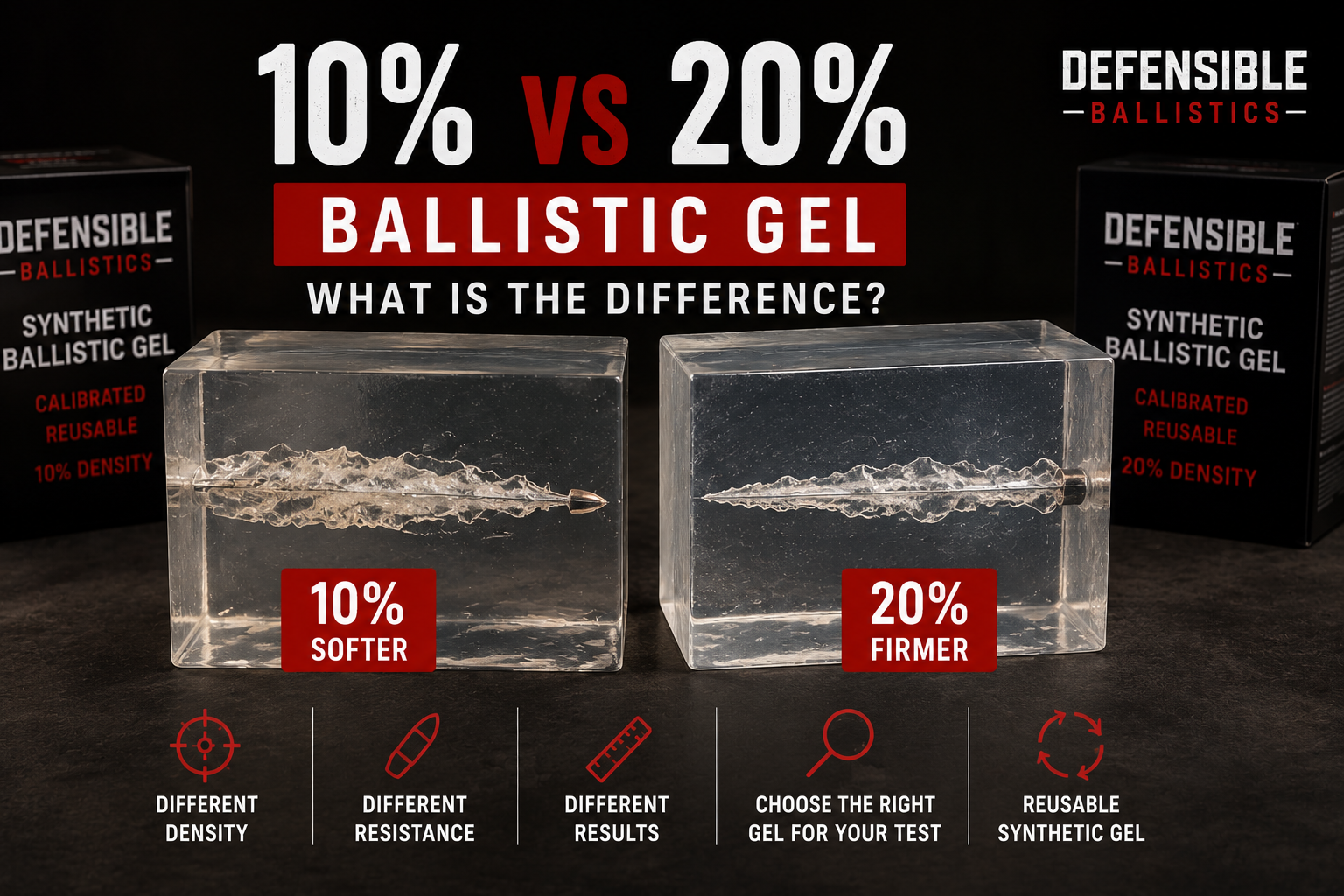
When choosing ballistic gel, one of the most common questions is whether to use 10% ballistic gel or 20% ballistic gel.
Both are designed to provide a controlled soft-tissue simulant for testing, but they are not the same. The main difference is the density and firmness of the gel, which affects how the test medium responds during impact.
At Defensible Ballistics, synthetic ballistic gel is available in calibrated options including 10% forensic/FBI-style density and 20% NATO-style density. Choosing the right one depends on what you are testing, the level of resistance required and the type of result you want to observe.
What does 10% ballistic gel mean?
10% ballistic gel refers to a softer gel formulation that is commonly used as a forensic-style soft-tissue simulant.
It is often chosen for general ballistic testing, airgun testing, education, research and demonstration work because it provides a softer medium that is suitable for observing penetration, expansion, deformation and wound path behaviour.
In simple terms, 10% ballistic gel is the softer option.
It is commonly used when the aim is to observe:
Penetration depth
Projectile expansion
Projectile deformation
Wound path shape
Energy transfer
General soft-tissue simulation
At Defensible Ballistics, our 10% synthetic ballistic gel is calibrated out of the bag and can be reused when handled correctly.
Synthetic Ballistic Gel (Select 10% for the density)
What does 20% ballistic gel mean?
20% ballistic gel is a firmer and denser gel formulation. It is commonly associated with NATO-style testing and is selected when a higher level of resistance is required.
Compared with 10% gel, 20% ballistic gel will feel noticeably firmer. This can make it suitable for testing where the user wants a denser soft-tissue simulant or a more resistant test medium.
In simple terms, 20% ballistic gel is the firmer option.
It is commonly used when the aim is to test against a denser medium or when a firmer block is required for the application.
At Defensible Ballistics, our 20% synthetic ballistic gel is also calibrated out of the bag and can be melted and reused multiple times when handled correctly.
Synthetic Ballistic Gel (Select 20% for the density)
The simple difference
The easiest way to understand the difference is this:
10% ballistic gel is softer and commonly used for forensic/FBI-style testing.
20% ballistic gel is firmer and commonly used for NATO-style testing.
Both can be useful, but they are intended to represent different testing requirements.
Comparison table
| Feature | 10% Ballistic Gel | 20% Ballistic Gel |
|---|---|---|
| General feel | Softer | Firmer |
| Common description | Forensic / FBI-style density | NATO-style density |
| Resistance | Lower resistance | Higher resistance |
| Typical use | General testing, forensic-style testing, airgun testing and demonstrations | Denser-medium testing, NATO-style testing and firmer block applications |
| Reusable when synthetic | Yes | Yes |
| Transparent when synthetic | Yes | Yes |
| Available as blocks | Yes | Yes |
| Available as chips | Yes | Yes |
Which one should you choose?
The right choice depends on what you want the test to show.
Choose 10% ballistic gel if you want a softer forensic-style testing medium. This is usually the better option for general use, airgun testing, educational demonstrations and customers who are new to ballistic gel.
Choose 20% ballistic gel if you need a firmer, denser medium. This may be the better option when you require a more resistant test block or are working to a NATO-style testing requirement.
When 10% ballistic gel is usually the better choice
10% ballistic gel is often the best starting point for customers who want a general-purpose test medium.
It is especially useful for:
Airgun pellet and slug testing
Demonstration videos
Educational content
General comparison testing
Forensic-style soft-tissue simulation
Observing wound paths and projectile behaviour
Because it is softer, 10% gel can make penetration and deformation easier to observe, especially with lower-energy projectiles.
When 20% ballistic gel is usually the better choice
20% ballistic gel is useful when a firmer test medium is needed.
It may be chosen for:
NATO-style testing
Higher-resistance demonstrations
Professional testing environments
Applications requiring a denser block
Situations where 10% gel may be too soft for the intended test
Because 20% gel is firmer, it provides greater resistance and can be useful where the user wants a more robust testing medium.
Does the percentage affect transparency?
With synthetic ballistic gel, both 10% and 20% options can be transparent, allowing users to observe the wound path inside the block.
Transparency is one of the main advantages of synthetic ballistic gel. It allows the tester to inspect penetration, travel direction, fragmentation and deformation without immediately cutting into the block.
This makes synthetic gel particularly useful for photography, video, product comparison and visual demonstrations.
Does the percentage affect reusability?
With Defensible Ballistics synthetic ballistic gel, both 10% and 20% options are reusable when handled correctly.
The gel can be melted, filtered where required, recast into a mould and used again. This makes synthetic ballistic gel a practical option for repeated testing, especially when compared with single-use or less reusable alternatives.
How to Melt and Reuse Synthetic Ballistic Gel
Blocks or chips?
Both 10% and 20% synthetic ballistic gel can be supplied as ready-made blocks or as chips.
Blocks are convenient and ready to use. They are ideal if you want a prepared product with minimal setup.
Chips are designed to be melted and cast into a mould. They are useful if you want to create your own block size, refill a mould or produce a custom shape.
Ballistic Gel Moulds
What about natural ballistic gel?
Natural ballistic gel is traditionally prepared from gelatine powder and water. At Defensible Ballistics, natural ballistic gel is supplied as a 10% forensic/FBI-style option.
Natural gel requires preparation, setting and temperature control. It can be a good option for customers who want a traditional gelatine-based testing medium.
Synthetic gel, by comparison, is supplied ready-calibrated and can be reused by melting and recasting.
Natural Ballistic Gel
Common mistake: choosing based only on price
One mistake customers can make is choosing gel based only on price rather than the purpose of the test.
The better question is not simply “which is cheaper?” but:
Which density is right for what I need to test?
If you are carrying out general testing, demonstrations, airgun testing or forensic-style work, 10% may be the better fit. If you need a firmer medium or a NATO-style density, 20% may be the better choice.
Summary
The main difference between 10% and 20% ballistic gel is firmness.
10% ballistic gel is softer and commonly used for forensic/FBI-style testing, general demonstrations and airgun testing.
20% ballistic gel is firmer and commonly used for NATO-style testing or situations where a denser medium is required.
Both options are available from Defensible Ballistics as synthetic ballistic gel blocks and chips. Synthetic gel is transparent, calibrated and reusable when handled correctly, making it a practical choice for repeated testing and clear visual analysis.
Explore 10% and 20% ballistic gel
Defensible Ballistics supplies synthetic ballistic gel in both 10% forensic/FBI-style density and 20% NATO-style density.
Browse our synthetic ballistic gel blocks and chips to choose the right option for your testing application.