

Synthetic Ballistic Gel vs Natural Ballistic Gel
Introduction
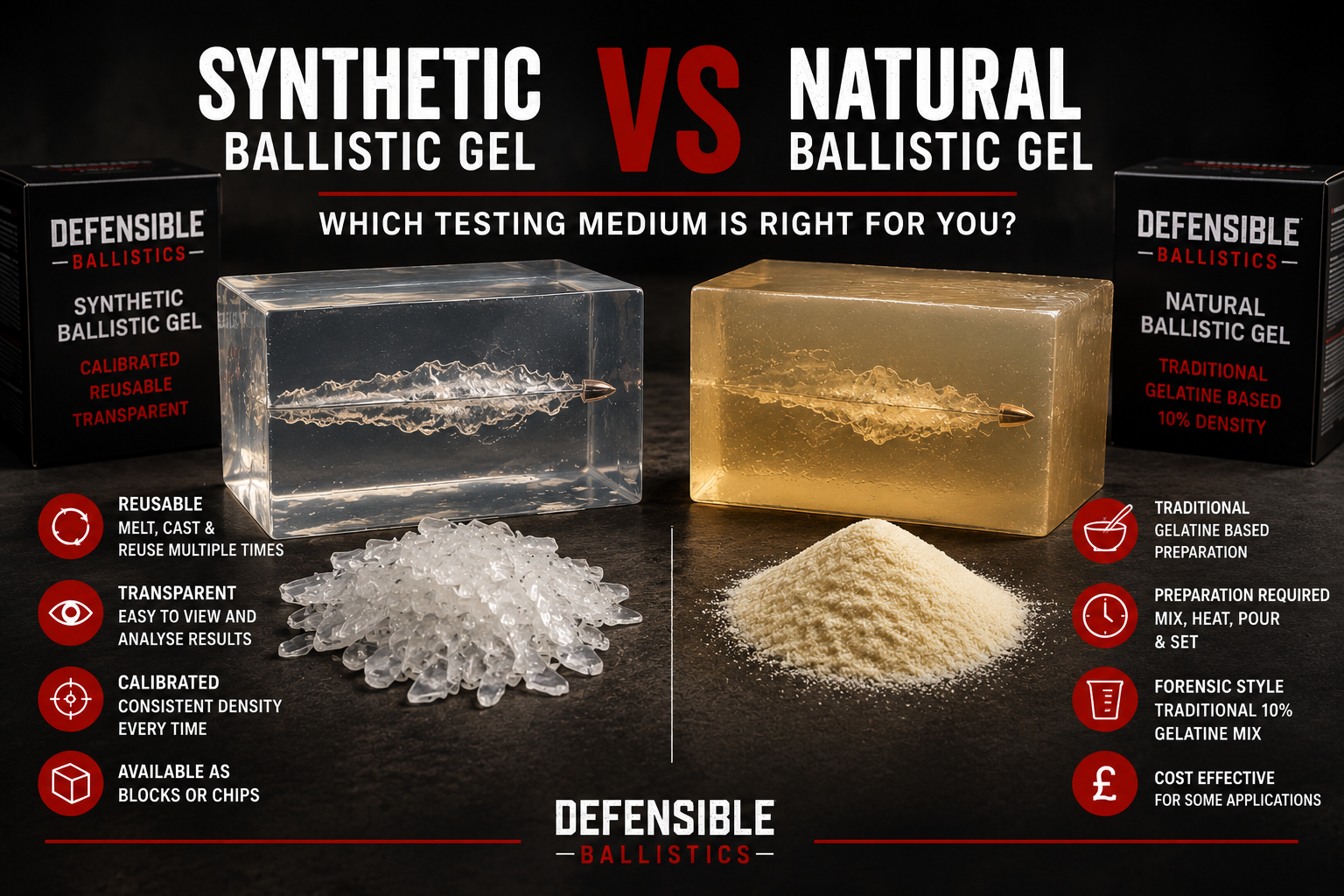
When choosing ballistic gel, one of the most important decisions is whether to use synthetic ballistic gel or natural ballistic gel.
Both products are designed to provide a soft testing medium for controlled testing, but they behave differently. The best choice depends on how often you test, whether you need transparency, whether you want to reuse the material and how much preparation you are willing to do.
At Defensible Ballistics, we supply both synthetic ballistic gel and natural ballistic gel, allowing customers to choose the most suitable product for their application.
What is synthetic ballistic gel?
Synthetic ballistic gel is a reusable testing medium designed to be transparent, calibrated and practical for repeated use.
It is supplied ready to use in block form or as chips that can be melted and cast into a mould. Synthetic gel can be reheated, melted and recast multiple times when handled correctly, making it a good option for users who want a long-term testing material.
Defensible Ballistics synthetic ballistic gel is available in calibrated options, including 10% forensic/FBI-style densityand 20% NATO-style density.
Synthetic ballistic gel is commonly chosen because it is:
Transparent
Reusable
Calibrated
Easy to inspect after testing
Suitable for repeated demonstrations
Available as blocks or chips
Suitable for melting and recasting
What is natural ballistic gel?
Natural ballistic gel is a traditional gelatine-based testing medium. It is commonly supplied as a powder and prepared by mixing with water, heating, pouring and setting.
Natural ballistic gel is often associated with forensic-style testing and is usually prepared as a 10% gelatine mixture. It can be a good choice for users who want a traditional testing medium and are comfortable preparing the gel before use.
Defensible Ballistics natural ballistic gel is supplied as a 10% forensic/FBI-style product.
Natural ballistic gel is commonly chosen because it is:
Traditional
Gelatine-based
Suitable for forensic-style testing
Supplied as powder
Cost-effective for some applications
Useful where traditional preparation is preferred
The simple difference
The easiest way to understand the difference is this:
Synthetic ballistic gel is the reusable and transparent option.
It is best suited to users who want to test repeatedly, inspect the wound path easily and recast the material after use.
Natural ballistic gel is the traditional gelatine-based option.
It is best suited to users who want a traditional forensic-style testing medium and are prepared to mix, heat, pour and set the gel before use.
Preparation
One of the biggest differences between synthetic and natural ballistic gel is preparation.
Synthetic ballistic gel is supplied ready to use when purchased as a block. If supplied as chips, it can be melted and cast into a mould. Once set, it can be used for testing.
Natural ballistic gel requires more preparation. The gelatine powder must be mixed with water, allowed to bloom, heated carefully, poured into a mould and left to set. Temperature control and preparation technique are important for achieving a consistent result.
If you want the simplest option, synthetic blocks are usually the easiest place to start.
Reusability
Synthetic ballistic gel is designed to be reusable. After testing, it can be cut up, melted, filtered where required and cast again.
This makes synthetic gel a practical choice for:
Repeated testing
Demonstration videos
Product comparisons
Training environments
Regular airgun testing
Customers who want better long-term value
Natural ballistic gel is generally not reused in the same way. It is a prepared gelatine product and is normally treated as a more traditional single-preparation medium.
If reusability is important, synthetic ballistic gel is usually the better choice.
Transparency
Transparency is another major advantage of synthetic ballistic gel.
Because synthetic gel is transparent, users can inspect the path of travel inside the block. This makes it easier to photograph, film and compare results without immediately cutting into the gel.
This is useful for observing:
Penetration depth
Wound path shape
Projectile deformation
Fragmentation
Direction of travel
Energy transfer
Natural ballistic gel can vary in appearance depending on preparation and handling. It may not provide the same level of visual clarity as synthetic gel.
If seeing the wound path clearly is important, synthetic ballistic gel is usually the better option.
Calibration and density
Defensible Ballistics synthetic ballistic gel is supplied calibrated out of the bag in different density options, including 10% forensic/FBI-style and 20% NATO-style.
This allows customers to choose between a softer or firmer synthetic gel depending on the application.
Natural ballistic gel is commonly prepared as a 10% gelatine-based product and requires correct preparation to achieve consistent results.
As a simple guide:
10% synthetic ballistic gel is softer and commonly used for forensic/FBI-style testing, airgun testing and general demonstrations.
20% synthetic ballistic gel is firmer and commonly used for NATO-style testing or where a denser medium is needed.
Natural ballistic gel is a traditional 10% gelatine-based option for customers who want a conventional preparation method.
10% vs 20% Ballistic Gel: What Is the Difference?
Storage and handling
Synthetic and natural ballistic gel also differ in how they are stored and handled.
Synthetic ballistic gel is more practical for regular users because it can be stored, reused and remelted. It should still be kept clean and handled carefully to preserve the quality of the material.
Natural ballistic gel requires more attention to temperature and preparation. Because it is gelatine-based, storage conditions and preparation quality have a greater effect on the finished block.
If you want a product that is easier to store and reuse, synthetic gel will usually be the more convenient option.
Blocks or chips?
Synthetic ballistic gel is available as ready-made blocks or as chips.
Synthetic blocks are the most convenient option. They arrive pre-formed and ready for testing.
Synthetic chips are better when you want to melt and cast your own block size or shape. They are useful for customers using steel moulds or creating custom test pieces.
Natural ballistic gel is supplied as powder and must be mixed and prepared before use.
Which is best for airgun testing?
For airgun testing, synthetic ballistic gel is often the most practical option.
It gives users a transparent block that can show pellet or slug penetration, deformation and wound path. It can also be reused, which makes it useful for regular testing and comparison videos.
Natural ballistic gel can also be used, but it requires more preparation and is generally less convenient for repeated hobby testing.
For most airgun users, 10% synthetic ballistic gel is a good starting point.
Which is best for forensic-style testing?
Both synthetic and natural ballistic gel can be relevant for forensic-style testing, depending on the purpose of the work.
Natural ballistic gel is the traditional gelatine-based option and may be preferred where that preparation method is specifically required.
Synthetic ballistic gel is useful when transparency, reusability and convenience are important.
The right choice depends on whether the user needs a traditional gelatine medium or a reusable transparent testing material.
Which is best for regular testing?
For regular testing, synthetic ballistic gel is usually the better choice.
The ability to reuse, remelt and recast the material makes it more practical for users who test frequently. It is also easier to inspect visually and can be used for product demonstrations, photography and video content.
Natural ballistic gel may be suitable for occasional tests where traditional gelatine preparation is preferred, but it is less convenient for repeated use.
Common mistake: assuming both products are used the same way
A common mistake is assuming synthetic and natural ballistic gel are interchangeable in every situation.
Although both are soft testing media, they are not handled in the same way.
Synthetic gel is designed around transparency and reusability. Natural gel is designed around traditional gelatine preparation.
Before choosing a product, it is worth considering how often you plan to test, whether you need to reuse the material and whether visual inspection through the block is important.
Summary
Synthetic ballistic gel and natural ballistic gel both have useful roles in controlled testing.
Synthetic ballistic gel is transparent, reusable, calibrated and practical for repeated use. It is available as blocks and chips and can be melted and recast when handled correctly.
Natural ballistic gel is a traditional gelatine-based testing medium supplied as powder. It is prepared by mixing with water, heating, pouring and setting.
For customers who want convenience, transparency and reusability, synthetic ballistic gel is usually the best option. For customers who want a traditional gelatine-based medium, natural ballistic gel remains a useful choice.
Explore Defensible Ballistics gel products
Defensible Ballistics supplies synthetic ballistic gel blocks, synthetic ballistic gel chips and natural ballistic gel for testing, demonstration, research and professional applications.
Browse the product range to choose the right ballistic gel for your test.