

How to Choose the Right Ballistic Gel for Your Test
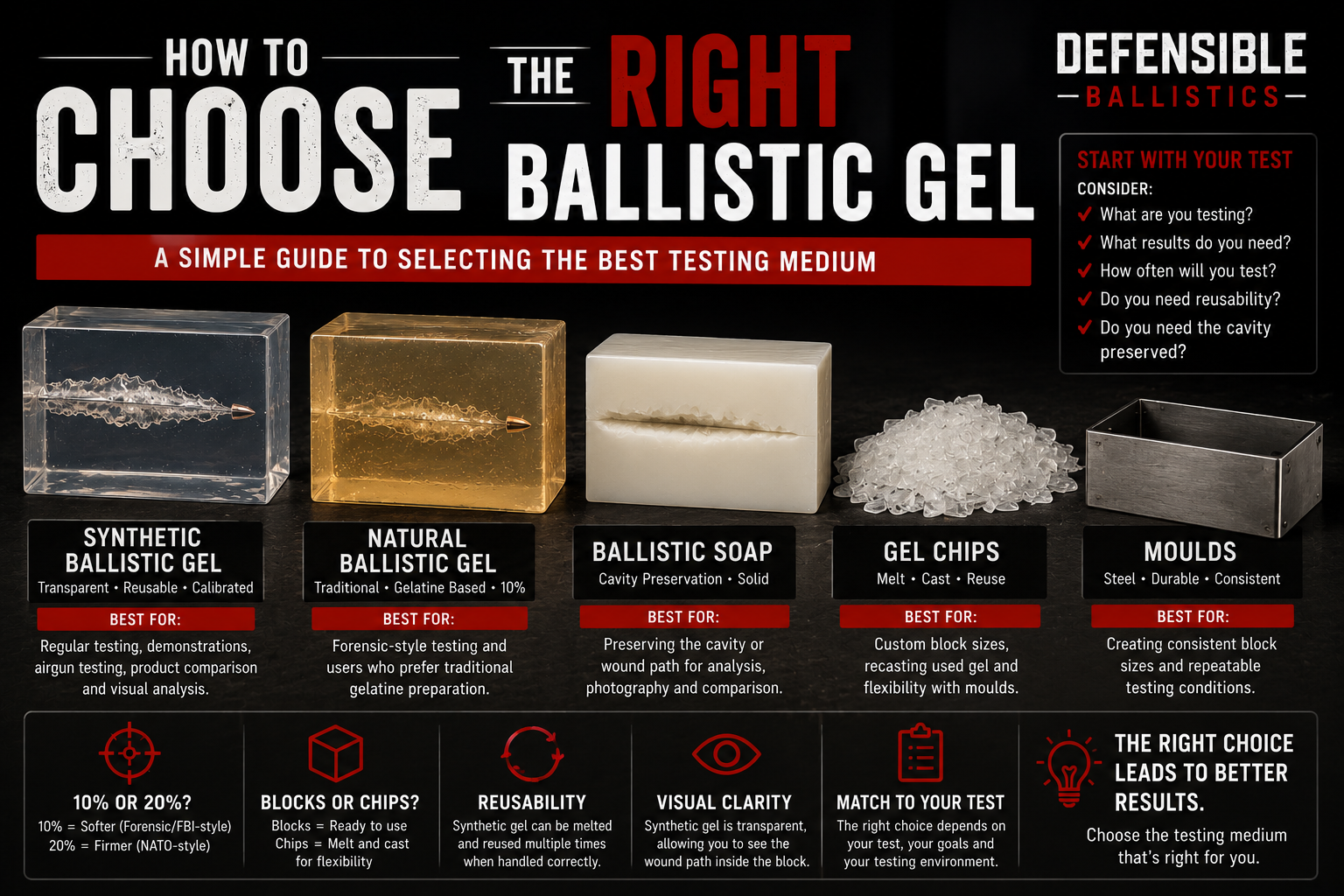
Introduction
Choosing the right ballistic gel depends on what you are testing, how often you plan to test and what type of results you need to observe.
Some users need a transparent and reusable gel for regular testing. Others need a traditional gelatine-based medium. Some customers want a ready-made block, while others need chips that can be melted and cast into a mould.
At Defensible Ballistics, we supply a range of ballistic testing materials, including synthetic ballistic gel, natural ballistic gel, ballistic soap, gel chips and moulds. This guide explains how to choose the right option for your test.
Start with the purpose of the test
The first question to ask is:
What do you need the test to show?
Ballistic gel can be used to observe different things, including:
Penetration depth
Wound path shape
Projectile expansion
Projectile deformation
Fragmentation
Energy transfer
Comparison between different projectiles or materials
Demonstration and training results
Once you know what you need to observe, it becomes easier to choose the right product.
Choose synthetic ballistic gel if you want reusability
Synthetic ballistic gel is usually the best choice when you want a reusable and transparent testing medium.
It can be used, melted, recast and used again when handled correctly. This makes it ideal for customers who carry out regular testing or want better long-term value from their gel.
Synthetic ballistic gel is a good choice for:
Airgun testing
Demonstration videos
Product comparison
Regular testing
Training environments
Customers who want to view the wound path inside the block
Users who want to melt and recast the material
Defensible Ballistics synthetic ballistic gel is available as ready-made blocks or as chips for melting and casting.
Choose natural ballistic gel if you want a traditional gelatine-based medium
Natural ballistic gel is a traditional gelatine-based testing material. It is supplied as a powder and prepared by mixing with water, allowing it to bloom, heating, pouring and setting.
It is a good choice for users who want a conventional 10% forensic-style gelatine product and are comfortable preparing the gel before use.
Natural ballistic gel is a good choice for:
Traditional gelatine preparation
Forensic-style testing
Controlled demonstrations
Users who prefer powder-based preparation
Occasional testing where reusability is less important
Natural gel requires more preparation than synthetic gel, but it remains a useful option where traditional gelatine-based testing is preferred.
Choose ballistic soap if you need cavity preservation
Ballistic soap is different from ballistic gel. It is used when the aim is to preserve the impact cavity or wound path more clearly after testing.
Gel can close back around the wound path after impact, whereas ballistic soap can hold the cavity shape more permanently. This makes it useful for visual inspection, photography, comparison and analysis.
Ballistic soap is a good choice for:
Preserving the cavity after impact
Demonstration and photography
Visual comparison
Analytical testing
Situations where the wound path needs to remain visible
If your main priority is cavity preservation rather than reusability or transparency, ballistic soap may be the better option.
Decide between 10% and 20% ballistic gel
If you are choosing synthetic ballistic gel, the next decision is usually whether you need 10% or 20% density.
The simple difference is:
10% ballistic gel is softer.
It is commonly used for forensic/FBI-style testing, airgun testing, general demonstrations and comparison work.
20% ballistic gel is firmer.
It is commonly used for NATO-style testing or where a denser and more resistant medium is required.
For many general users, 10% synthetic ballistic gel is a good starting point. For users who need a firmer block or a denser medium, 20% may be more suitable.
10% vs 20% Ballistic Gel: What Is the Difference?
Choose a ready-made block if you want convenience
Ready-made ballistic gel blocks are the most convenient option.
They are already cast into a usable shape, which means you can start testing without having to melt chips or prepare powder. This is useful for customers who want a simple and practical product with minimal setup.
Ready-made blocks are a good choice for:
First-time users
Airgun testing
Demonstration content
Simple comparison tests
Customers who want minimal preparation
Users who want a clean and consistent block shape
If you want the easiest route into ballistic gel testing, a ready-made synthetic block is usually the best place to start.
Choose gel chips if you want flexibility
Synthetic ballistic gel chips are designed to be melted and cast into a mould.
They are useful when you want to create your own block size, refill a mould, cast a custom shape or reuse synthetic gel after previous testing.
Gel chips are a good choice for:
Casting into moulds
Custom block sizes
Recasting used synthetic gel
Larger testing projects
Users who already have a mould
Customers who want more control over shape and size
If you need flexibility rather than a pre-made block, synthetic gel chips are usually the better option.
Synthetic Ballistic Gel Chips
Ballistic Gel Moulds
Use a mould if repeatability matters
A mould helps create consistent ballistic gel blocks. This is useful when you want repeatable tests or a clean, standardised block size.
Using a mould also helps when melting and casting synthetic gel chips. It gives the gel a defined shape and makes the finished block easier to handle, store and test.
A mould is useful if you want:
Consistent block dimensions
Cleaner casting
Repeatable test conditions
Easier preparation
Standardised testing blocks
A more professional presentation
Defensible Ballistics supplies steel moulds in different sizes to support a range of testing applications.
Consider how often you will test
How often you test should influence the product you choose.
If you only need to carry out a one-off or occasional test, a ready-made block or natural ballistic gel may be suitable.
If you plan to test regularly, synthetic ballistic gel is usually more practical because it can be reused. The ability to melt and recast the material makes it a better long-term option for repeated testing.
As a simple guide:
Occasional testing: Ready-made block or natural ballistic gel
Regular testing: Synthetic ballistic gel block or chips
Custom casting: Synthetic ballistic gel chips and mould
Cavity preservation: Ballistic soap
Consider whether you need visual clarity
If you need to see the wound path inside the block, synthetic ballistic gel is usually the best choice.
Its transparency allows users to observe the impact path without immediately cutting into the block. This is especially useful for photography, video, demonstrations and comparison tests.
Visual clarity is useful when you want to inspect:
Penetration depth
Projectile travel path
Fragmentation
Expansion
Deformation
Energy transfer
If the test needs to be clearly shown or recorded, synthetic ballistic gel is likely to be the most suitable option.
Consider your testing environment
Different environments may suit different products.
For example, a hobby airgun tester may want a simple ready-made 10% synthetic block. A professional testing environment may require a firmer 20% block or a custom-cast shape. A demonstration or analysis setup may benefit from ballistic soap because it preserves the cavity clearly.
Think about where the testing will take place, how much preparation space you have and whether you need to move or store the material after use.
Common recommendations
For most first-time users, a 10% synthetic ballistic gel block is a good starting point. It is transparent, reusable and simple to use.
For regular users, synthetic ballistic gel chips with a mould provide more flexibility and better long-term practicality.
For users who want a traditional gelatine-based material, natural ballistic gel is the better choice.
For users who need the cavity to remain clearly visible after impact, ballistic soap may be the most suitable option.
Common mistake: choosing the product before defining the test
A common mistake is choosing a product before deciding what the test needs to show.
Before buying ballistic gel, ask yourself:
Do I need the material to be reusable?
Do I need to see through the block?
Do I need a softer or firmer test medium?
Do I need a ready-made block or a custom size?
Do I need to preserve the cavity after impact?
Am I testing once, occasionally or regularly?
These questions will usually point you towards the right product.
Summary
The right ballistic gel depends on your testing purpose.
Choose synthetic ballistic gel if you want a transparent, reusable and practical testing medium.
Choose natural ballistic gel if you want a traditional gelatine-based forensic-style material.
Choose ballistic soap if you need the cavity or wound path to be preserved after impact.
Choose blocks if you want convenience, and choose chips with a mould if you want flexibility and custom casting.
By matching the product to the test, you will get more useful results and a better testing experience.
Explore Defensible Ballistics products
Defensible Ballistics supplies synthetic ballistic gel blocks, synthetic ballistic gel chips, natural ballistic gel, ballistic soap and steel moulds for testing, demonstration, training and research applications.
Browse the full product range to choose the right testing medium for your application.