

What Is Forensic Ballistic Gel? A Simple Guide
Introduction
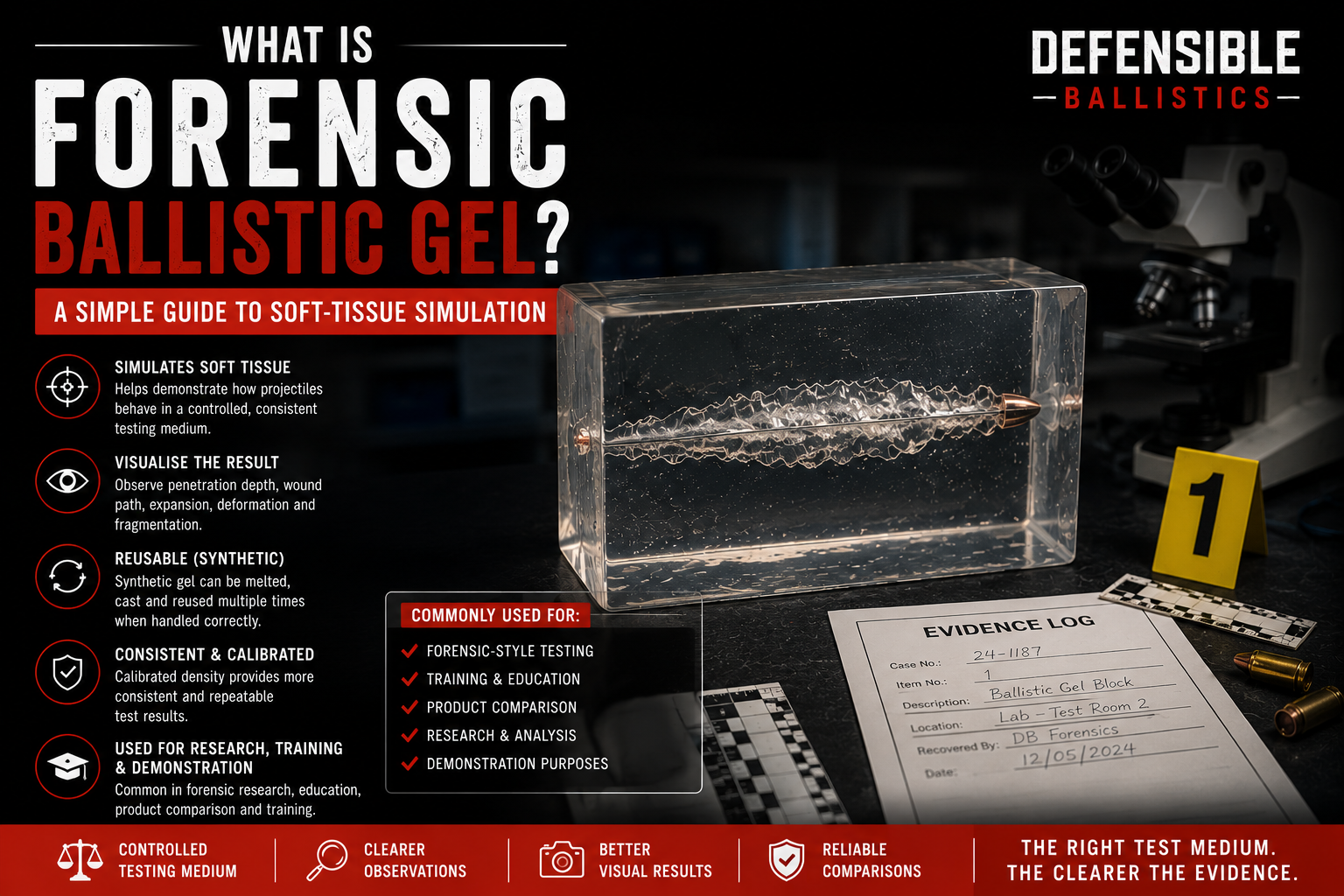
“Forensic” ballistic gel is a specialist testing medium used to help simulate the behaviour of soft tissue during controlled testing and is normally the designation for 10% density natural gel that is 250-260A.
It is commonly used to observe how a projectile, fragment or other object travels through a soft medium. This can help demonstrate penetration depth, wound path, deformation, expansion and energy transfer.
At Defensible Ballistics, we supply ballistic gel products suitable for forensic-style testing, demonstrations, research and training applications.
What does forensic ballistic gel mean?
Forensic ballistic gel usually refers to a soft-tissue simulant used in testing and demonstration work. It is designed to provide a consistent medium that can help users observe what happens during an impact.
The purpose of forensic ballistic gel is not to perfectly recreate the human body. The human body contains skin, fat, muscle, bone, organs, blood vessels and many different tissue types. Ballistic gel is instead used as a controlled and repeatable medium that allows results to be compared more clearly.
In simple terms, forensic ballistic gel helps show:
How far a projectile travels
The shape of the wound path
Whether a projectile expands or deforms
Whether fragmentation occurs
How energy is transferred into the test medium
How different projectiles or materials compare
Why is ballistic gel used in forensic-style testing?
Ballistic gel is useful because it provides a clear and practical way to observe impact behaviour.
When a projectile passes through gel, it leaves a visible path. This allows the tester to inspect the direction of travel, depth of penetration and the effect on the surrounding material.
This makes ballistic gel useful for:
Demonstrations
Training
Product comparison
Research
Educational content
Controlled testing
Visual analysis
Because the medium is consistent, it can also help compare different test items under similar conditions.
Is forensic ballistic gel the same as human tissue?
No. Ballistic gel is a tissue simulant, not a direct copy of the human body.
It is designed to behave as a useful comparison medium, but it does not contain the same complex structures found in real tissue. For example, it does not include bone, organs, skin layers or different tissue densities unless those are added separately using specialist inserts or test setups.
This is why ballistic gel should be understood as a controlled testing material rather than a complete human body substitute.
Why is 10% ballistic gel commonly used?
10% ballistic gel is commonly associated with forensic/FBI-style testing because it provides a softer test medium suitable for observing penetration and wound path behaviour.
At Defensible Ballistics, 10% gel is available as both synthetic ballistic gel and natural ballistic gel.
As a simple guide:
10% ballistic gel is softer and is commonly used for forensic-style testing, airgun testing, demonstrations and general comparison work.
20% ballistic gel is firmer and is commonly used for NATO-style testing or where a denser medium is required.
For many forensic-style applications, 10% gel is the more common starting point.
10% vs 20% Ballistic Gel: What Is the Difference?
Synthetic forensic-style ballistic gel
Synthetic ballistic gel is a transparent and reusable testing medium. It is supplied calibrated and can be used in block form or melted and cast from chips.
For forensic-style demonstrations, synthetic gel has several advantages. Because it is transparent, users can see the wound path inside the block without immediately cutting into it. This is useful for photography, video, comparison work and visual inspection.
Synthetic ballistic gel is useful when you want:
A transparent testing medium
A reusable material
Easy visual inspection
Calibrated density
Ready-made blocks
Chips for melting and casting
A practical option for repeated testing
Defensible Ballistics synthetic ballistic gel is available in 10% forensic/FBI-style density and 20% NATO-style density.
Natural forensic ballistic gel
Natural ballistic gel is a traditional gelatine-based testing medium. It is supplied as powder and prepared by mixing with water, allowing it to bloom, heating, pouring and setting.
Natural ballistic gel is commonly associated with traditional forensic-style gel preparation. It can be a good option for customers who want a gelatine-based product and are prepared to carry out the preparation process.
Natural ballistic gel is useful when you want:
A traditional gelatine-based medium
10% forensic-style preparation
A powder product for mixing
A conventional testing material
A cost-effective option for some applications
Natural gel requires more preparation than synthetic gel, but it remains a useful option where traditional gelatine-based testing is preferred.
What can forensic ballistic gel show?
Forensic ballistic gel can help show the behaviour of a projectile or test object after impact.
Depending on the test, it may help demonstrate:
Penetration depth
Permanent wound path
Temporary cavity effects
Projectile expansion
Projectile deformation
Fragmentation
Direction of travel
Comparison between different projectiles
This is why it is commonly used in demonstrations and controlled test environments.
What are its limitations?
Although ballistic gel is useful, it has limitations.
It does not fully replicate the human body. It does not naturally contain bones, organs, skin layers or mixed tissue types. The result seen in gel should therefore be treated as a controlled test result rather than an exact prediction of real-world injury.
The quality of the result can also depend on:
The type of gel used
The density of the gel
The temperature of the gel
How the gel was prepared
The distance and setup of the test
Whether the gel is supported or contained
Whether additional materials are used in front of or inside the gel
For best results, testing should be carried out in a controlled and consistent way.
Ballistic gel vs ballistic soap for forensic-style analysis
Ballistic soap is another testing medium that can be useful for visual analysis.
The key difference is that ballistic soap can preserve the cavity more permanently after impact. Gel can close back around the wound path, while soap can hold the cavity shape more clearly.
This makes ballistic soap useful for:
Preserving the cavity
Photography
Demonstration
Visual comparison
Analytical testing
Ballistic gel is often better when transparency and reusable testing are important. Ballistic soap is often better when preserving the cavity shape is the priority.
Ballistic Soap
Choosing the right forensic-style gel
The right product depends on what you need from the test.
Choose 10% synthetic ballistic gel if you want a transparent, reusable forensic-style testing medium.
Choose natural ballistic gel if you want a traditional gelatine-based 10% product and are comfortable preparing the gel.
Choose 20% synthetic ballistic gel if you need a firmer NATO-style medium.
Choose ballistic soap if you need the cavity or wound path to remain clearly preserved after impact.
Common mistake: assuming all ballistic gel is the same
A common mistake is assuming that all ballistic gel products behave the same way.
In reality, the material type, density, preparation and temperature can all affect the result. Synthetic gel, natural gel and ballistic soap each have different advantages.
Before choosing a product, it is worth asking:
Do I need transparency?
Do I need reusability?
Do I need a traditional gelatine-based product?
Do I need a 10% or 20% density?
Do I need the cavity to remain preserved?
Am I testing once or repeatedly?
Answering these questions will help you select the right testing medium.
Summary
Forensic ballistic gel is a controlled soft-tissue simulant used to observe penetration, wound path, deformation, expansion and energy transfer.
10% ballistic gel is commonly used for forensic/FBI-style testing because it provides a softer medium suitable for general testing and visual demonstrations.
Synthetic ballistic gel offers transparency, reusability and convenient handling. Natural ballistic gel offers a traditional gelatine-based preparation. Ballistic soap is useful when cavity preservation is the main priority.
By choosing the correct material for the test, users can achieve clearer, more useful and more consistent results.
Explore Defensible Ballistics forensic-style testing products
Defensible Ballistics supplies synthetic ballistic gel, natural ballistic gel, ballistic soap, gel chips and moulds for forensic-style testing, training, demonstrations and research applications.
Browse the product range to choose the right testing medium for your application.