

Why Calibration Matters in Ballistic Gel Testing
Introduction
Calibration is one of the most important parts of ballistic gel testing.
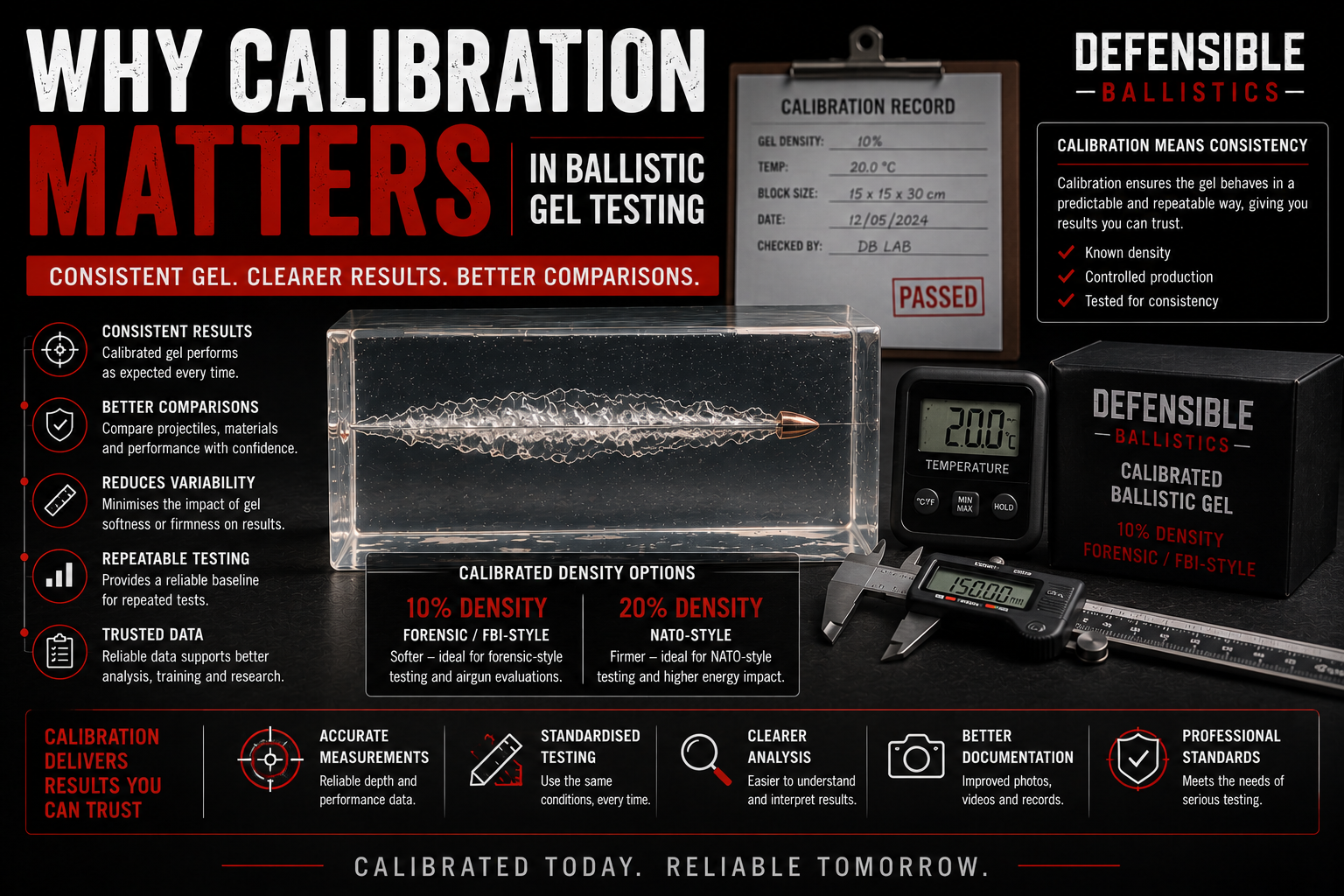
When ballistic gel is calibrated, it means the material has been produced or prepared to behave in a consistent and expected way. This matters because ballistic gel is often used for comparison, demonstration, research and training. If the gel is too soft, too firm or inconsistent, the results can become harder to interpret.
At Defensible Ballistics, our synthetic ballistic gel is supplied calibrated out of the bag in different densities, including 10% forensic/FBI-style density and 20% NATO-style density.
What does calibration mean?
In simple terms, calibration means that the gel has been made to a known and controlled specification.
Ballistic gel is used as a soft-tissue simulant. For it to be useful, the material needs to respond consistently during testing. If one block is much softer than another, or if a block changes unpredictably between tests, then the results are less reliable.
Calibration helps make sure that the gel behaves as expected.
This is important when testing:
Penetration depth
Wound path shape
Projectile expansion
Projectile deformation
Fragmentation
Energy transfer
Comparison between different projectiles or materials
Why does calibration matter?
Calibration matters because ballistic gel is often used to compare results.
For example, if you test two different projectiles in two different gel blocks, you want the gel itself to be as consistent as possible. Otherwise, it becomes difficult to know whether the difference came from the projectile or from the gel.
A calibrated gel helps provide a more reliable testing medium, making the results easier to understand and compare.
Consistency creates better comparisons
One of the main reasons to use ballistic gel is to compare results in a controlled way.
This might include comparing:
Two different airgun pellets
Two different slugs
Two different ammunition types
A product before and after a design change
Different protective materials
Different test distances
Different testing conditions
If the gel is inconsistent, the comparison becomes less useful. A softer block may allow deeper penetration. A firmer block may reduce penetration. If the tester does not know how the gel is behaving, the result becomes harder to interpret.
Calibrated gel helps reduce this problem by making the test medium more consistent.
Calibration helps reduce guesswork
Without calibration, test results can become misleading.
A projectile may appear to perform better or worse simply because the gel was not consistent. This is especially important when customers are using gel for product comparison, training, demonstration videos or research.
Calibration does not make every test perfect, but it does help remove one major source of uncertainty: the test medium itself.
The more consistent the gel, the more useful the result.
10% and 20% calibrated ballistic gel
Defensible Ballistics synthetic ballistic gel is available in calibrated densities, including 10% forensic/FBI-style densityand 20% NATO-style density.
The simple difference is:
10% ballistic gel is softer.
It is commonly used for forensic/FBI-style testing, airgun testing, general demonstrations and comparison work.
20% ballistic gel is firmer.
It is commonly used for NATO-style testing or where a denser and more resistant medium is required.
Choosing the correct density is part of achieving a useful test result. A test using 10% gel will not behave the same as a test using 20% gel.
10% vs 20% Ballistic Gel: What Is the Difference?
Calibration and synthetic ballistic gel
Synthetic ballistic gel has an advantage because it is supplied ready-calibrated and can be reused when handled correctly.
This makes it practical for users who want to carry out repeated testing while maintaining consistency between uses.
Synthetic ballistic gel is useful when customers want:
Calibrated density
Transparency
Reusability
Repeatable testing
Visual inspection of the wound path
Ready-made blocks
Chips for melting and casting
Because the material can be melted and recast, it is a practical option for customers who test regularly.
Calibration and natural ballistic gel
Natural ballistic gel is a traditional gelatine-based testing medium. It is usually supplied as powder and prepared by mixing with water, allowing it to bloom, heating, pouring and setting.
With natural gel, correct preparation is especially important. The final result can be affected by the ratio of gelatine to water, the heating process, the setting time and the storage temperature.
This means natural ballistic gel requires more care during preparation to achieve consistent results.
Natural gel can be useful for traditional forensic-style testing, but users need to follow the preparation instructions carefully.
Temperature and handling matter
Even with calibrated gel, handling conditions can affect the result.
Ballistic gel should be stored, prepared and used correctly. Temperature, contamination, overheating, poor mixing or repeated handling can all influence the quality of the finished test block.
Good handling helps protect the consistency of the material.
Customers should always follow the product instructions for:
Heating
Melting
Pouring
Setting
Storage
Reuse
Cleaning
Recasting
Good preparation and handling help preserve the value of calibrated gel.
Why calibration matters for airgun testing
Airgun users often use ballistic gel to compare pellets, slugs and other projectiles.
For this type of testing, calibration is important because lower-energy projectiles can be more affected by changes in gel firmness. If one block is softer than another, penetration depth may appear greater. If the block is firmer, penetration may appear reduced.
Using a consistent gel makes comparisons more meaningful.
For many airgun users, 10% synthetic ballistic gel is a practical starting point because it is softer, transparent and reusable.
Why calibration matters for professional testing
In professional testing environments, calibration is even more important.
Law enforcement, military, forensic, academic and research users often need results that can be compared, recorded and explained clearly.
Calibrated ballistic gel supports this by providing a controlled testing medium. It helps reduce variation and makes the result easier to interpret.
For professional users, choosing the correct density and using consistent preparation methods are essential.
Why calibration matters for video and demonstrations
Many users create videos, product demonstrations or educational content using ballistic gel.
In these cases, calibration helps make the demonstration more credible. Viewers can better understand the result when the gel is consistent and the testing medium is clearly described.
A calibrated gel block also helps create clearer visual content because the user can explain what was tested and why that particular gel density was chosen.
Common mistake: comparing results from different gel types
A common mistake is comparing results from different gel types as if they are identical.
For example, a test carried out in 10% gel should not be directly compared with a test carried out in 20% gel without explaining the difference. Likewise, synthetic gel and natural gel may require different handling and preparation.
When comparing results, always consider:
The gel type
The gel density
The preparation method
The temperature
The block size
The test distance
The test setup
Whether the gel has been reused
Calibration is important, but it is only one part of a good test.
How to get more consistent results
To improve consistency, try to keep the test conditions as controlled as possible.
Good practice includes:
Use the same gel density for comparison tests
Use the same block size where possible
Follow the product instructions
Keep the gel clean
Avoid overheating synthetic gel
Use a suitable mould for recasting
Record the test distance and setup
Compare like-for-like products
Label results clearly
Consistency makes the final result easier to interpret.
Summary
Calibration matters because ballistic gel is used as a controlled testing medium.
A calibrated gel helps produce more consistent results, clearer comparisons and more reliable demonstrations. It reduces guesswork and makes it easier to understand whether differences in performance come from the test item rather than the gel itself.
Defensible Ballistics supplies calibrated synthetic ballistic gel in 10% forensic/FBI-style density and 20% NATO-style density. We also supply natural ballistic gel, ballistic soap, gel chips and moulds for a range of testing, training and research applications.
Explore calibrated ballistic gel
Defensible Ballistics supplies synthetic ballistic gel blocks and chips in calibrated density options.
Browse our product range to choose the right calibrated ballistic gel for your test.