

Ballistic Gel for Airgun Testing: A Beginner’s Guide
Introduction
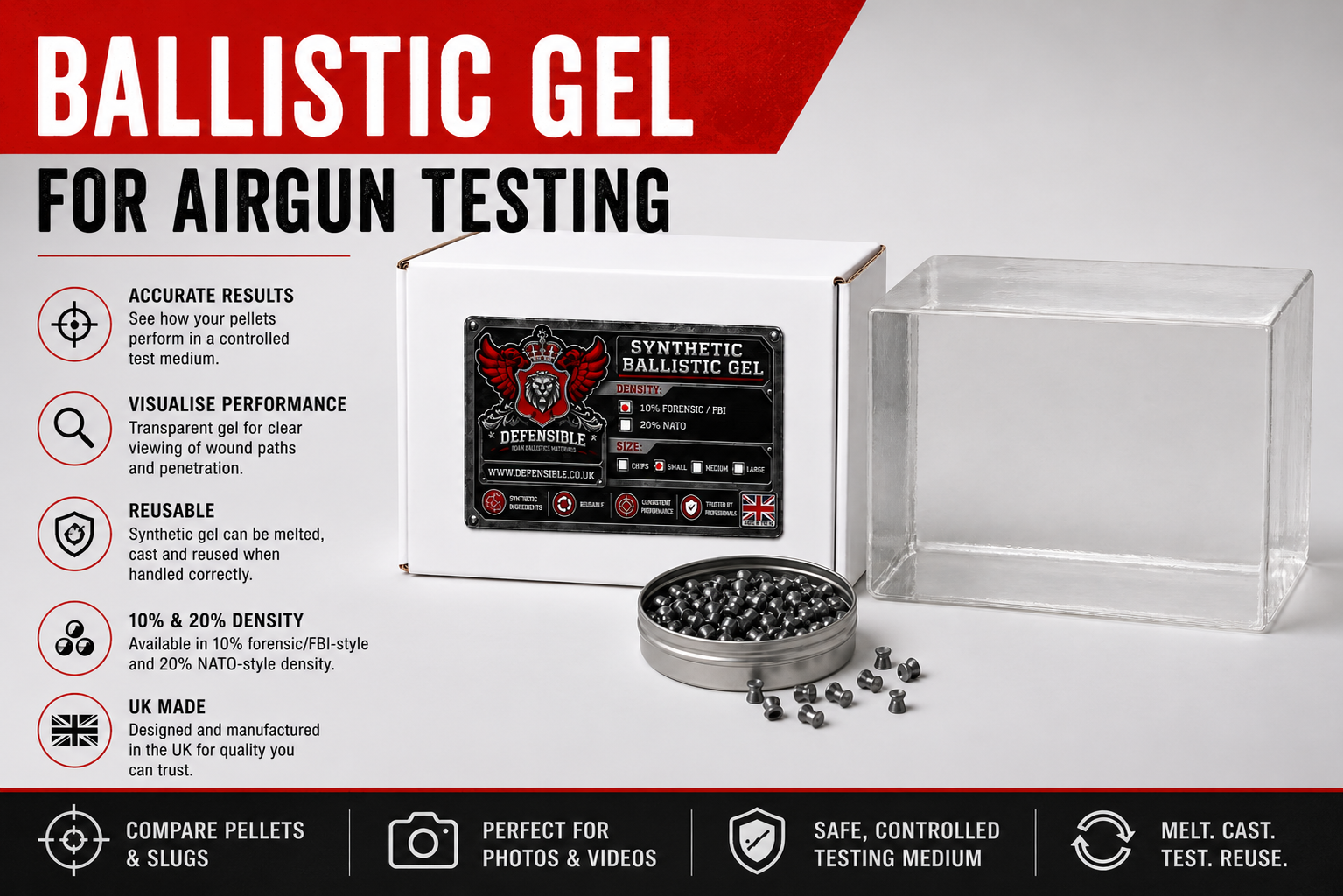
Ballistic gel is a useful testing medium for airgun users who want to compare pellets, slugs and different airgun setups in a more visual way.
Instead of only shooting at paper targets, metal targets or backstops, ballistic gel allows the user to observe what happens after impact. It can show penetration depth, wound path, pellet deformation and energy transfer inside a soft test medium.
At Defensible Ballistics, our synthetic ballistic gel is transparent, calibrated and reusable, making it a practical choice for airgun testing, product comparisons and demonstration videos.
Why use ballistic gel for airgun testing?
Airgun testing is often about understanding performance.
Different pellets and slugs can behave very differently, even when fired from the same airgun. Some may penetrate deeply. Some may deform. Some may tumble. Others may create a wider wound path or transfer energy more quickly.
Ballistic gel helps make these differences easier to see.
It can be used to compare:
Pellet penetration
Slug penetration
Pellet expansion
Pellet deformation
Wound path shape
Energy transfer
Different airgun power levels
Different distances
Different pellet weights
Different projectile designs
For airgun users, ballistic gel gives a clear visual result that is easier to understand and record.
What can ballistic gel show?
Ballistic gel can help show how a pellet or slug behaves after impact.
Depending on the test, it may show:
How far the pellet travels into the gel
Whether the pellet expands or deforms
Whether the pellet tumbles or changes direction
The shape of the wound path
Whether fragments are left behind
How different pellets compare under similar conditions
This makes ballistic gel useful for practical testing and for creating educational content.
Why synthetic ballistic gel is useful for airgun testing
Synthetic ballistic gel is often a good option for airgun users because it is transparent and reusable.
The transparency allows the user to see the wound path inside the block. This makes it easier to photograph, film and compare results without immediately cutting the gel apart.
The reusability also makes synthetic gel practical for regular testing. After use, it can be melted, recast and used again when handled correctly.
Synthetic ballistic gel is useful for airgun testing because it is:
Transparent
Reusable
Calibrated
Easy to inspect visually
Suitable for repeated testing
Available as ready-made blocks
Available as chips for melting and casting
Small Synthetic Ballistic Gel Block
Why 10% ballistic gel is a good starting point
For many airgun users, 10% synthetic ballistic gel is a good starting point.
10% gel is softer than 20% gel and is commonly used for forensic/FBI-style testing, general demonstrations and comparison work. Because airguns usually produce lower energy than firearms, a softer gel is often more useful for observing penetration and projectile behaviour.
As a simple guide:
10% ballistic gel is softer and usually better for general airgun testing.
20% ballistic gel is firmer and may be used where a denser, more resistant medium is required.
For most beginner airgun tests, 10% synthetic ballistic gel is the more practical option.
Suggested internal link: 10% vs 20% Ballistic Gel: What Is the Difference?
Blocks or chips for airgun testing?
Airgun users can choose between ready-made synthetic ballistic gel blocks and synthetic gel chips.
Ready-made blocks are the easiest option. They arrive already cast and ready to use, making them ideal for first-time users.
Synthetic gel chips are designed to be melted and cast into a mould. They are useful if you want to create your own block size, refill a mould or reuse gel after testing.
For beginners, a ready-made 10% synthetic ballistic gel block is usually the simplest choice. For regular testers, chips and a mould can offer more flexibility.
Setting up an airgun gel test
A good test setup helps produce better results.
Before testing, think about:
The airgun being used
The pellet or slug type
The test distance
The gel density
The block size
The backstop
The lighting
The camera angle if filming
Safety precautions
Try to keep the setup consistent if you are comparing different pellets or slugs. If the test distance, gel type or airgun power changes, the results may not be directly comparable.
Safety first
Ballistic gel does not replace a safe backstop.
When using ballistic gel for airgun testing, always ensure there is a suitable backstop behind the gel. Pellets or slugs may pass through the gel, especially at higher power levels or shorter distances.
Good safety practice includes:
Use a safe and legal shooting area
Use a proper backstop
Wear suitable eye protection
Keep bystanders clear
Check what is behind the target
Handle airguns responsibly
Follow all relevant laws and club rules
Ballistic gel is a testing medium, not a safety barrier.
Keep the test consistent
Consistency is important if you want useful results.
If you are comparing two pellets, try to keep everything else the same. Use the same airgun, same distance, same gel density and similar shot placement.
For better comparisons, record:
Pellet or slug type
Pellet weight
Airgun model
Power level if known
Test distance
Gel density
Block size
Temperature and conditions if relevant
Penetration depth
Visual observations
The more consistent the setup, the more meaningful the comparison becomes.
Photographing and filming airgun gel tests
Synthetic ballistic gel is useful for photography and video because it is transparent.
To get clearer results:
Use good lighting
Place the gel against a clean background
Film from the side if possible
Record before and after shots
Use slow motion if available
Mark or measure penetration depth
Keep the block clean
Avoid clutter around the test area
Clear visuals help make the result easier to understand, especially when comparing different pellets or slugs.
Reusing synthetic ballistic gel after airgun testing
One of the major advantages of synthetic ballistic gel is that it can be reused.
After testing, the gel can be cut into smaller pieces, melted and recast into a mould. This allows users to get more use from the material over time.
Before remelting, remove visible debris where possible. Pellets, fragments, dirt or contamination should be removed to help keep the gel clean.
Reusable gel is especially useful for airgun users who test regularly.
Synthetic Ballistic Gel Instructions
Common mistake: not using a backstop
A common mistake is assuming that ballistic gel will always stop the pellet or slug.
This is not guaranteed. Depending on the airgun, distance, projectile and gel block size, the pellet may pass through the gel.
Always use a safe backstop behind the gel.
Common mistake: comparing different tests unfairly
Another common mistake is comparing results from different setups.
For example, a pellet fired at close range into 10% gel cannot be directly compared with another pellet fired at a different distance into 20% gel.
If you want a fair comparison, keep the test conditions as consistent as possible.
Common mistake: choosing a block that is too small
Block size matters.
If the gel block is too small, the projectile may pass through too quickly or leave the block before its behaviour can be properly observed.
For higher-powered airguns or deeper-penetrating slugs, a larger block may be more useful.
How to Choose the Right Ballistic Gel for Your Test
Common mistake: testing before the gel is ready
If synthetic gel has been freshly cast, it should be allowed to cool and set fully before use.
Testing too soon may affect the result because the gel may still be warm or softer than intended. Allow the gel to reach a stable condition before testing.
Is ballistic gel worth it for airgun testing?
For many airgun users, ballistic gel is worth it because it provides a visual result that paper or metal targets cannot show.
It helps demonstrate what happens after impact and allows users to compare different projectiles in a more informative way.
Synthetic ballistic gel can be especially good value for regular users because it can be reused, melted and recast when handled correctly.
Summary
Ballistic gel is a useful testing medium for airgun users who want to compare pellets, slugs and different setups.
It can help show penetration depth, wound path, deformation and energy transfer. For many users, 10% synthetic ballistic gel is a good starting point because it is transparent, reusable and suitable for general airgun testing.
For best results, use a consistent setup, record your test conditions and always use a safe backstop behind the gel.
Explore ballistic gel for airgun testing
Defensible Ballistics supplies synthetic ballistic gel blocks, synthetic ballistic gel chips and steel moulds for airgun testing, demonstrations, training and research applications.
Browse the product range to choose the right ballistic gel for your test.