

Ballistic Gel for Law Enforcement and Military Testing
Introduction
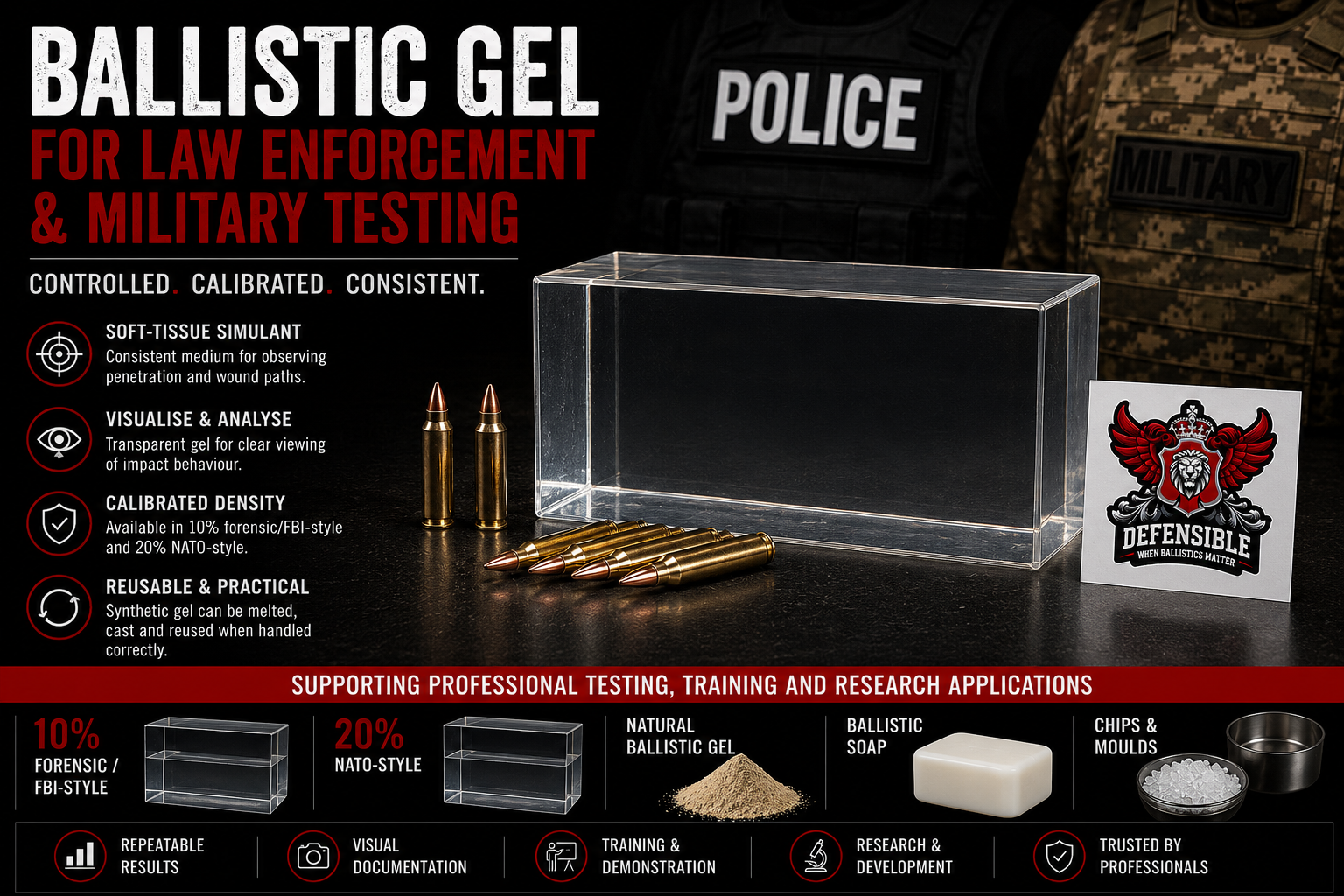
Ballistic gel is widely used as a controlled soft-tissue simulant for testing, training, demonstration and research.
For law enforcement, military and professional testing environments, the value of ballistic gel comes from its ability to provide a consistent medium for observing impact behaviour. It can help show penetration depth, wound path, projectile deformation, fragmentation and energy transfer in a clear and repeatable way.
At Defensible Ballistics, we supply synthetic ballistic gel, natural ballistic gel, ballistic soap, gel chips and moulds for professional, research and training applications.
Why ballistic gel is used in professional testing
Professional testing requires a medium that is consistent, measurable and easy to document.
Ballistic gel provides a practical way to observe how a projectile or test object behaves after impact. It allows users to visually inspect the path through the material and compare results under controlled conditions.
Ballistic gel is commonly used for:
Training demonstrations
Research and development
Product comparison
Ammunition evaluation
Protective equipment testing
Forensic-style testing
Visual documentation
Education and familiarisation
The aim is to create a repeatable test medium that helps users understand and compare results more clearly.
What ballistic gel can show
Ballistic gel can help demonstrate several important factors during testing.
These may include:
Penetration depth
Permanent wound path
Temporary cavity effects
Projectile expansion
Projectile deformation
Fragmentation
Direction of travel
Energy transfer
Comparison between different projectiles or materials
Because the result is visible within the gel, it can also be useful for photography, video recording, reporting and training presentations.
Ballistic gel as a soft-tissue simulant
Ballistic gel is often used as a soft-tissue simulant. This means it is designed to behave as a controlled comparison medium rather than a perfect recreation of the human body.
The human body contains many different tissues and structures, including skin, fat, muscle, organs and bone. Ballistic gel does not reproduce all of these features on its own. Instead, it provides a consistent medium that allows tests to be compared more clearly.
For more advanced test setups, additional materials or inserts may be used to represent specific structures or barriers, depending on the purpose of the test.
The importance of calibration
Calibration is especially important in professional testing.
If the gel is too soft, too firm or inconsistent, the results may become harder to interpret. A calibrated gel helps reduce uncertainty by ensuring the test medium behaves in a known and controlled way.
This matters when comparing:
Different projectiles
Different ammunition types
Different protective materials
Different test distances
Different block sizes
Different densities
Different test conditions
At Defensible Ballistics, our synthetic ballistic gel is supplied calibrated out of the bag in different density options.
Why Calibration Matters in Ballistic Gel Testing
10% forensic/FBI-style ballistic gel
10% ballistic gel is the softer option and is commonly used for forensic/FBI-style testing, demonstrations and comparison work.
It is often chosen when the user wants a softer soft-tissue simulant for observing penetration, expansion, deformation and wound path behaviour.
10% gel is useful for:
Forensic-style testing
Demonstrations
Training
Research
General comparison testing
Visual analysis
Lower-resistance soft-tissue simulation
For many professional and educational applications, 10% gel provides a useful starting point.
20% NATO-style ballistic gel
20% ballistic gel is firmer and denser than 10% gel.
It is commonly associated with NATO-style testing or situations where a more resistant test medium is required. Because it is firmer, it can be useful where the test requires a denser block or where a softer gel may not be suitable.
20% gel is useful for:
NATO-style testing
Higher-resistance testing
Professional demonstrations
Denser-medium comparison
More robust test setups
Applications requiring a firmer block
Choosing between 10% and 20% depends on the purpose of the test and the result the user needs to observe.
10% vs 20% Ballistic Gel: What Is the Difference?
Synthetic ballistic gel for professional users
Synthetic ballistic gel is often useful in law enforcement and military testing because it is transparent, calibrated and reusable.
The transparency allows users to inspect the wound path inside the block. This makes it easier to photograph, film and document the result.
The reusability makes synthetic gel practical for repeated testing. After use, it can be melted, cast and reused when handled correctly.
Synthetic ballistic gel is useful when users need:
Transparent visual analysis
Calibrated density
Repeatable testing
Reusability
Ready-made blocks
Chips for melting and casting
Clear photography and video results
Professional product demonstrations
Natural ballistic gel for traditional testing
Natural ballistic gel is a traditional gelatine-based testing medium.
It is supplied as powder and prepared by mixing with water, heating, pouring and setting. It can be useful where a traditional 10% gelatine-based preparation is preferred.
Natural gel requires more preparation and temperature control than synthetic gel, but it remains a useful option for customers who want a conventional gelatine-based medium.
Natural ballistic gel is useful when users need:
A traditional gelatine-based product
10% forensic-style preparation
Powder-based gel
Controlled preparation
A conventional testing material
Ballistic soap for cavity preservation
Ballistic soap is different from ballistic gel.
It is used when the aim is to preserve the impact cavity or wound path more clearly after testing. Gel can close back around the wound path, while ballistic soap can hold the cavity shape more permanently.
This makes ballistic soap useful for:
Cavity preservation
Demonstration
Photography
Visual comparison
Analytical testing
Post-impact inspection
Ballistic gel is usually better when transparency and reusability are important. Ballistic soap is often better when the preserved cavity is the priority.
Ballistic Soap
Choose the Right Ballistic Gel
Blocks, chips and moulds
Professional users may require different gel formats depending on the test.
Ready-made blocks are convenient and can be used with minimal preparation. They are useful when a clean, standard block is needed quickly.
Synthetic gel chips are designed to be melted and cast into a mould. They are useful for custom block sizes, recasting used gel and repeated preparation.
Steel moulds help create consistent block dimensions. This supports repeatability and makes the finished blocks easier to handle, store and document.
Synthetic Ballistic Gel Chips
Ballistic Gel Moulds
Why repeatability matters
Repeatability is important in professional testing because results often need to be compared and explained.
If the test medium, distance, block size or density changes between tests, the comparison may be less reliable. Using consistent gel and a controlled setup helps make results easier to interpret.
Repeatable testing should consider:
Gel density
Gel type
Block dimensions
Test distance
Test angle
Projectile type
Environmental conditions
Temperature
Backing and support
Recording method
The more consistent the test conditions, the more useful the comparison becomes.
Documentation and reporting
Ballistic gel is useful for documentation because the result can be visually recorded.
Professional users may choose to photograph or film the test before, during and after impact. Transparent synthetic gel can be especially useful because the wound path can often be seen inside the block.
Good documentation may include:
Gel type and density
Block size
Test distance
Projectile or item tested
Environmental conditions
Date and location
Photographs
Video
Penetration measurements
Observed deformation or fragmentation
Clear records help make testing more useful and easier to review later.
Training and demonstration use
Ballistic gel can be useful for training because it provides a visual way to explain impact behaviour.
Instead of discussing performance only in theory, trainers can show the effect within a controlled medium. This may help demonstrate differences between projectiles, materials, distances or testing conditions.
For training environments, synthetic ballistic gel is often useful because it is transparent and reusable.
Research and development use
Ballistic gel can also support research and product development.
Users may compare different materials, projectile types or protective solutions under controlled conditions. Because gel provides a visible and measurable result, it can help support early-stage analysis and comparison.
For repeated research use, calibrated synthetic gel, chips and moulds can provide a practical testing system.
Common mistake: comparing different gel densities directly
A common mistake is comparing a result from 10% gel with a result from 20% gel as if the medium is the same.
Because 10% and 20% gel have different firmness, the results should be interpreted with that difference in mind.
For fairer comparison, use the same gel density and test setup wherever possible.
Common mistake: ignoring temperature and handling
Temperature and handling can affect gel behaviour.
Even calibrated gel should be stored, prepared and used correctly. Overheating, contamination, poor casting or testing before the gel has properly set can affect results.
Good handling helps preserve the quality and consistency of the testing medium.
Common mistake: treating gel as a complete body substitute
Ballistic gel is a soft-tissue simulant, not a complete replacement for the human body.
It is useful for controlled comparison, but it does not naturally include bones, organs, skin layers or varied tissue structures. Any results should be understood in that context.
Summary
Ballistic gel is a valuable testing medium for law enforcement, military, forensic, training and research applications.
It helps users observe penetration, wound path, deformation, fragmentation and energy transfer in a controlled soft-tissue simulant. Calibration, density, consistency and handling all play an important role in producing useful results.
Defensible Ballistics supplies synthetic ballistic gel, natural ballistic gel, ballistic soap, gel chips and moulds to support professional testing, training and demonstration work.
Explore professional ballistic testing materials
Defensible Ballistics supplies calibrated synthetic ballistic gel in 10% forensic/FBI-style and 20% NATO-style density options, alongside natural ballistic gel, ballistic soap, chips and steel moulds.
Browse the product range to choose the right testing medium for your application.