

Ballistic Gel for Universities, Research and Training
Introduction
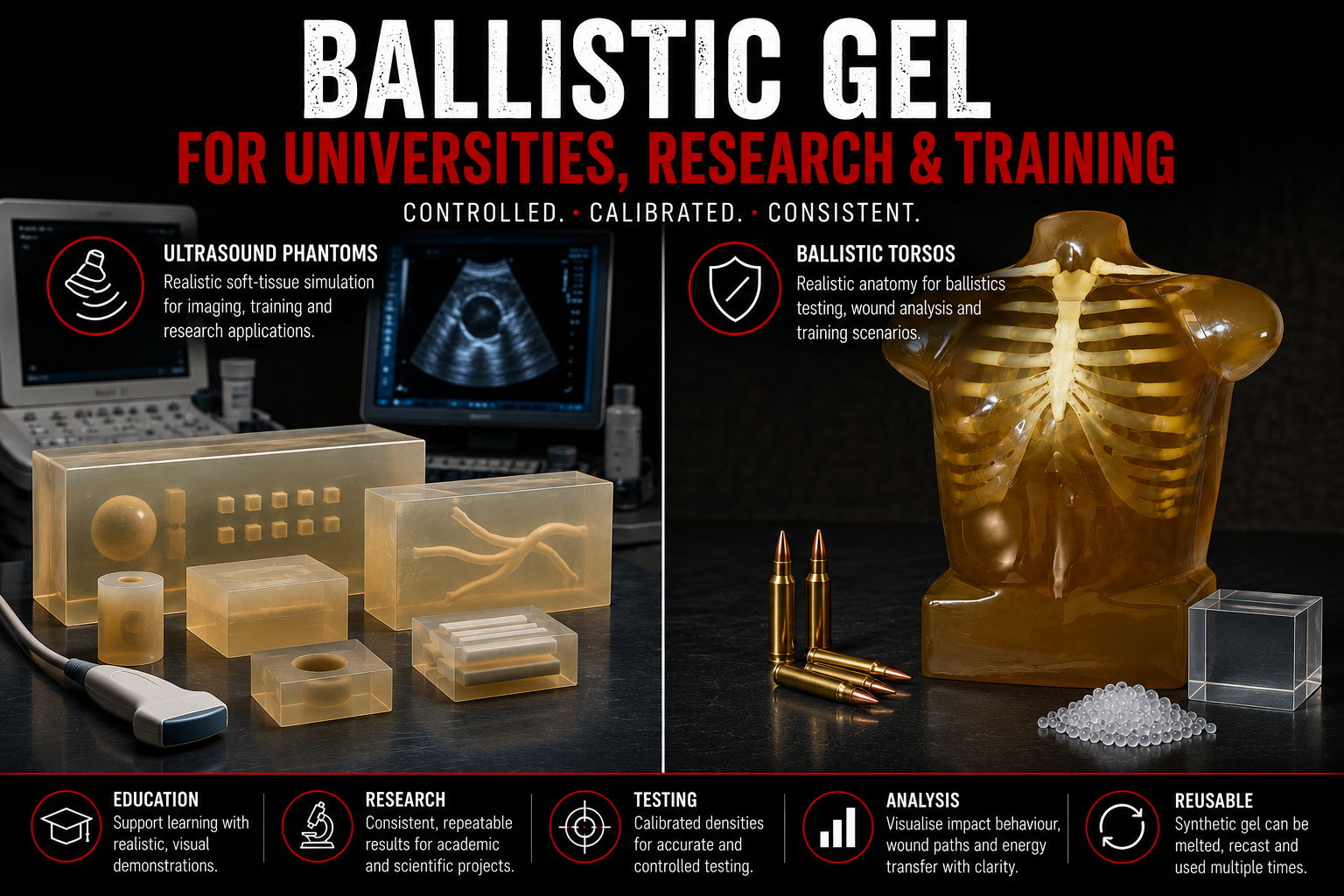
Ballistic gel is not only used for forensic or professional ballistic testing. It can also be a useful material for universities, research organisations, laboratories and training providers.
Because ballistic gel provides a controlled soft-tissue simulant, it can help demonstrate impact behaviour, penetration, wound paths, deformation, energy transfer and material response in a visual and repeatable way.
At Defensible Ballistics, we supply synthetic ballistic gel, natural ballistic gel, ballistic soap, gel chips, moulds and medical phantom materials for testing, education, research and demonstration use.
Why universities and researchers use ballistic gel
Universities and research teams often need materials that are consistent, measurable and easy to document.
Ballistic gel can be used as a practical test medium for projects involving impact behaviour, material testing, medical training, imaging research, product development and controlled demonstrations.
It is useful because it allows researchers and students to observe results that may otherwise be difficult to see.
Ballistic gel can help demonstrate:
Penetration depth
Wound path shape
Deformation
Fragmentation
Energy transfer
Material response
Soft-tissue simulation
Repeatable comparison testing
Visual documentation
A controlled soft-tissue simulant
Ballistic gel is commonly used as a soft-tissue simulant. It does not perfectly recreate the human body, but it provides a consistent medium that can be used for controlled testing and comparison.
This is useful in education and research because it allows the same material to be used across multiple demonstrations or trials, helping students and researchers compare results more clearly.
For some projects, gel may be used on its own. For others, it may be combined with inserts, barriers, bones, targets or specialist materials depending on the aim of the test.
Teaching and demonstration use
Ballistic gel is particularly useful in teaching because it makes impact behaviour easier to visualise.
Instead of explaining penetration, deformation or energy transfer only in theory, instructors can show students a physical test result. This can support learning in areas such as forensic science, engineering, defence studies, materials testing, medical simulation and product design.
Ballistic gel can be used for:
Classroom demonstrations
Laboratory practicals
Research projects
Training exercises
Product comparison
Visual learning
Student experiments
Controlled impact testing
Synthetic ballistic gel is especially useful for teaching because it is transparent and reusable.
Research and development use
Ballistic gel can support research and development where a consistent soft medium is required.
It may be used to compare projectiles, materials, protective equipment, tools, devices or inserts under controlled conditions. Because the result can be visually inspected and recorded, it can support early-stage testing and product development.
Researchers may use ballistic gel to investigate:
Penetration behaviour
Energy transfer
Impact effects
Material deformation
Device interaction with soft media
Training model design
Imaging visibility
Repeatability between tests
The value of ballistic gel comes from its ability to provide a consistent comparison medium.
Why calibration matters in research
Calibration is important because research and training environments often rely on repeatable results.
If the gel is inconsistent, too soft or too firm, the results may become harder to interpret. Calibrated gel helps reduce uncertainty by providing a more predictable testing medium.
Defensible Ballistics synthetic ballistic gel is supplied calibrated out of the bag in different density options, including 10% forensic/FBI-style density and 20% NATO-style density.
This allows users to choose the density most appropriate for their project.
10% ballistic gel for research and training
10% ballistic gel is the softer option and is commonly used for forensic/FBI-style testing, demonstrations and general comparison work.
It is often a good starting point for educational use because it provides a useful soft-tissue simulant for observing penetration, wound paths and deformation.
10% ballistic gel may be suitable for:
Forensic science teaching
Airgun and lower-energy demonstrations
General comparison testing
Soft-tissue simulation
Visual learning
Student projects
Introductory research work
10% vs 20% Ballistic Gel: What Is the Difference?
20% ballistic gel for firmer test requirements
20% ballistic gel is firmer and denser than 10% gel.
It may be selected where a more resistant test medium is required or where the project needs a firmer NATO-style density.
20% ballistic gel may be suitable for:
Denser-medium testing
Professional training
Higher-resistance demonstrations
Material comparison
NATO-style testing requirements
Projects requiring a firmer block
The correct density depends on the aim of the project and the type of result that needs to be observed.
Synthetic ballistic gel for universities
Synthetic ballistic gel is often a strong option for universities and training providers because it is transparent, calibrated and reusable.
The transparency makes it easier to see the result inside the block. This is useful for demonstrations, student observation, photography, video and reporting.
The reusability makes it practical for repeated teaching sessions and research trials. After testing, synthetic gel can be melted, recast and reused when handled correctly.
Synthetic ballistic gel is useful when users need:
A transparent testing medium
Calibrated density
Reusable material
Clear visual inspection
Repeatable teaching demonstrations
Blocks for immediate use
Chips for casting and custom work
Natural ballistic gel for traditional projects
Natural ballistic gel is a traditional gelatine-based medium supplied as powder.
It is prepared by mixing with water, heating, pouring and setting. It may be selected where a traditional 10% gelatine preparation is preferred.
Natural ballistic gel may be suitable for:
Traditional gelatine-based testing
Forensic-style projects
Research requiring powder preparation
Controlled laboratory preparation
Educational demonstrations
Natural gel requires more preparation than synthetic gel, but it remains useful where a traditional medium is required.
Ballistic soap for visual analysis
Ballistic soap is useful when the aim is to preserve the cavity or wound path more clearly after impact.
Unlike gel, which can close back around the wound path, ballistic soap can hold the cavity shape more permanently. This makes it useful for photography, measurement, demonstration and comparison.
Ballistic soap may be useful for:
Visual analysis
Preserving cavity shape
Demonstration work
Photography
Training displays
Comparative testing
Post-impact inspection
Suggested internal link: Ballistic Soap
Suggested internal link: Ballistic Soap vs Ballistic Gel
Medical phantom applications
Ballistic gel materials can also support medical and training phantom applications.
Soft gel materials may be used to create models for imaging, training, needle guidance, procedural practice or research demonstrations. Depending on the design, inserts can be added to simulate specific internal targets or structures.
Defensible Ballistics supplies medical phantom materials through Acousim, including configurable phantom blocks for imaging, training and research applications.
Medical phantom applications may include:
Ultrasound training
Imaging demonstrations
Needle guidance practice
Research models
Target insert testing
Procedural training
Custom educational phantoms
Blocks, chips and moulds for research projects
Different projects may require different gel formats.
Ready-made blocks are useful when a standard test medium is needed quickly with minimal preparation.
Synthetic gel chips are useful when a project requires custom casting, different block sizes or repeated recasting.
Moulds help produce consistent block dimensions, which is important when repeatability matters.
For university and research use, chips and moulds can be especially useful because they allow users to create blocks suited to the project rather than relying only on standard sizes.
Ballistic Gel Moulds
Documentation and reporting
Ballistic gel is useful in research and training because results can be photographed, filmed, measured and recorded.
Transparent synthetic gel is especially useful because the path can often be viewed inside the block before cutting or further inspection.
Good documentation may include:
Gel type
Gel density
Block size
Test distance
Test setup
Date and location
Environmental conditions
Photographs
Video
Measurements
Observations
Comparison notes
Clear documentation helps make testing more useful for teaching, reporting and future review.
Repeatability in academic testing
Repeatability is important in research and training.
If students or researchers are comparing results, the gel type, density, block size, temperature and test setup should be kept as consistent as possible.
Repeatable testing should consider:
Same gel density
Same block size
Same test distance
Same target position
Same projectile or test item
Same preparation method
Same casting method
Same documentation process
A controlled setup helps produce clearer and more useful results.
Common mistake: choosing the material before defining the project
A common mistake is choosing the gel before deciding what the project needs to show.
Before selecting a product, ask:
What are we testing?
Do we need transparency?
Do we need reusability?
Do we need a traditional gelatine-based medium?
Do we need a softer or firmer density?
Do we need to preserve the cavity?
Do we need a custom block size?
Will the material be used once or repeatedly?
These questions will usually point towards the right product.
Common mistake: comparing different test media directly
Synthetic gel, natural gel and ballistic soap all behave differently.
A result from one material should not be treated as identical to a result from another. If comparing results, it is important to clearly record the medium used and explain the difference.
For academic and research work, this is especially important because the test material forms part of the method.
Common mistake: overlooking storage and handling
Storage and handling can affect the quality of the test medium.
Synthetic gel should be kept clean and handled correctly if it is going to be reused. Natural gel requires careful preparation and temperature control. Ballistic soap should be handled in a way that preserves the cavity for inspection.
Following the product instructions helps protect the consistency and quality of the material.
Summary
Ballistic gel can be a valuable material for universities, research organisations and training providers.
It provides a controlled soft-tissue simulant that can support teaching, research, demonstration, product development, visual analysis and medical phantom applications.
Synthetic ballistic gel offers transparency, calibration and reusability. Natural ballistic gel offers a traditional gelatine-based option. Ballistic soap helps preserve cavity shape for inspection. Chips and moulds allow custom casting and repeatable block preparation.
By choosing the correct material for the project, universities and researchers can create clearer demonstrations, better comparisons and more useful test results.
Explore ballistic gel for research and training
Defensible Ballistics supplies synthetic ballistic gel, natural ballistic gel, ballistic soap, synthetic gel chips, steel moulds and medical phantom materials for education, research and training applications.
Browse the product range to choose the right testing medium for your project.