
What Is Ballistic Soap and When Should You Use It?
Introduction
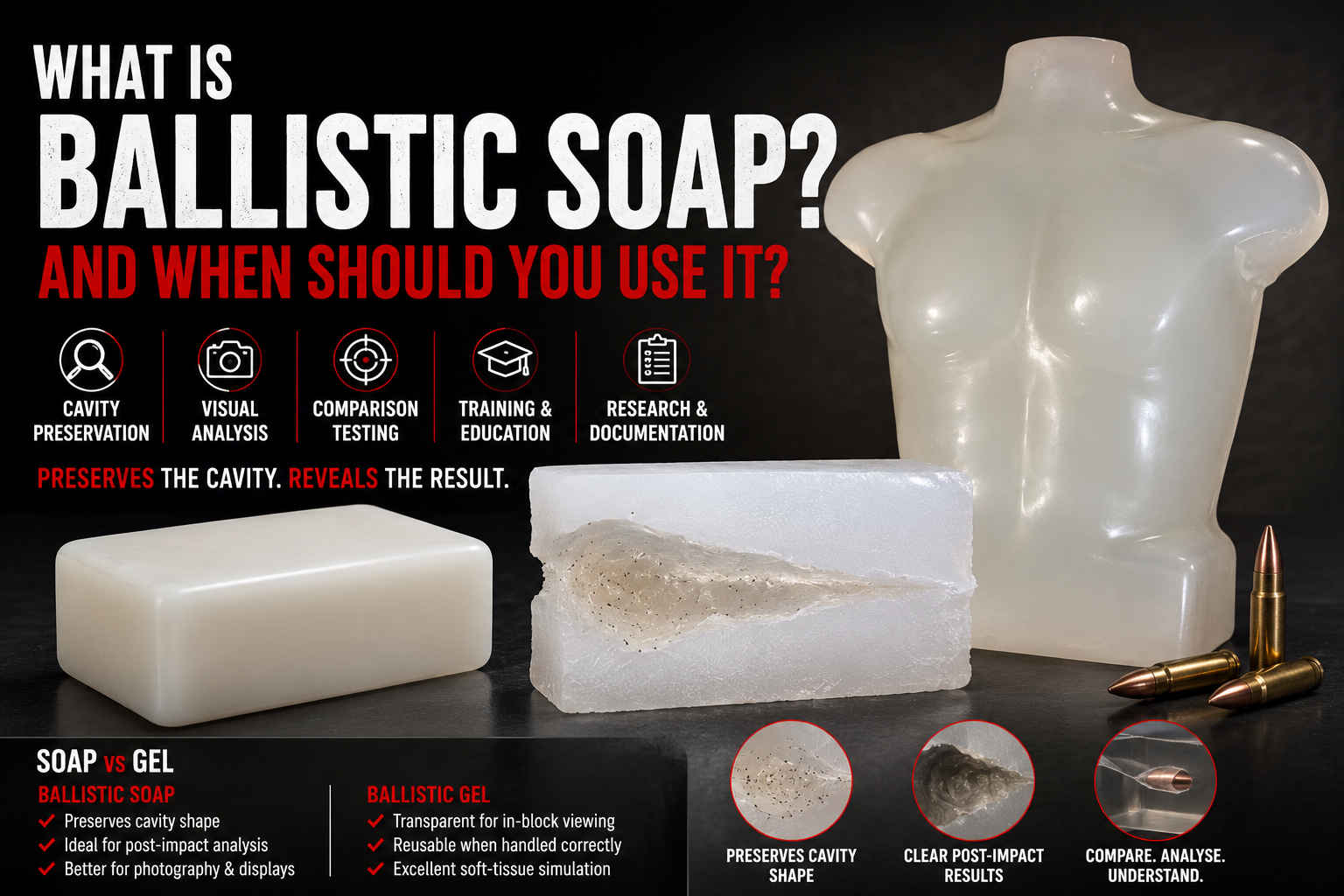
Ballistic soap is a specialist testing medium used to help preserve and examine the cavity or wound path created during an impact test.
While ballistic gel is often chosen for transparency and reusability, ballistic soap is useful when the aim is to preserve the impact cavity more clearly after testing. This makes it valuable for visual analysis, photography, demonstrations, research and comparison work.
At Defensible Ballistics, ballistic soap is supplied as part of our wider range of testing materials, alongside synthetic ballistic gel, natural ballistic gel, gel chips and moulds.
What is ballistic soap?
Ballistic soap is a solid testing medium used to show and preserve the effect of an impact.
When a projectile or test object passes through ballistic soap, it can leave a more permanent cavity. This makes the result easier to inspect after the test.
In simple terms, ballistic soap is useful when you want to see the shape of the impact path and preserve it for later examination.
Ballistic soap can help show:
Cavity shape
Penetration path
Direction of travel
Energy transfer
Expansion effects
Deformation effects
Comparison between different projectiles or test items
Why use ballistic soap?
The main reason to use ballistic soap is cavity preservation.
In some testing media, the wound path can partially close after impact. Ballistic soap behaves differently because it can hold the cavity shape more clearly. This means the result can be photographed, measured and examined after the test.
Ballistic soap is useful when you need:
A clear post-impact record
A preserved cavity
Better visual comparison
Demonstration material
Photography and documentation
A solid analytical medium
Easier inspection after testing
Ballistic soap vs ballistic gel
Ballistic soap and ballistic gel are both used as testing media, but they are not the same.
Ballistic gel is often chosen when transparency, soft-tissue simulation and visual inspection through the block are important. Synthetic ballistic gel is also reusable when handled correctly.
Ballistic soap is chosen when preserving the cavity shape is the priority. It is less about transparency and more about holding the impact path for later inspection.
The simple difference is:
Choose ballistic gel when you want to view the wound path inside the block.
Choose ballistic soap when you want the cavity to remain preserved after impact.
When should you use ballistic soap?
Ballistic soap is best used when the result needs to remain visible and measurable after the test.
It may be suitable for:
Visual analysis
Demonstration work
Photography
Comparison testing
Research projects
Training displays
Post-impact inspection
Cavity preservation
If the main goal is to preserve the wound path or temporary cavity for examination, ballistic soap may be the better option than gel.
When ballistic gel may be better
Ballistic gel may be the better choice when transparency and reusability are more important.
Synthetic ballistic gel is transparent, which allows the user to see the path inside the block. It can also be melted and reused multiple times when handled correctly.
Ballistic gel may be better if you want:
A transparent testing medium
A reusable material
Visual inspection during or immediately after testing
A softer tissue simulant
Ready-made blocks or chips
A medium for repeated testing
What can ballistic soap show?
Ballistic soap can help show the physical effect of an impact through a solid medium.
Depending on the test, it may help demonstrate:
How the cavity forms
How wide the cavity is
How deep the impact travels
Whether the path is straight or angled
Whether the projectile deforms
Whether energy is transferred quickly or gradually
How different projectiles compare
This can make ballistic soap useful for side-by-side comparisons and demonstration photography.
Why cavity preservation matters
Cavity preservation matters because it gives the user more time to inspect the result.
With some materials, the cavity may close back or become less obvious after impact. Ballistic soap helps keep the impact path visible, which is useful for analysis and documentation.
This can be especially useful for:
Training materials
Reports
Photographs
Videos
Comparative testing
Educational demonstrations
Research records
A preserved cavity can make the result easier to explain and review.
Is ballistic soap reusable?
Ballistic soap is generally used differently from synthetic ballistic gel.
Synthetic ballistic gel is designed to be melted and recast multiple times when handled correctly. Ballistic soap is normally chosen for its ability to preserve the cavity rather than for repeated reuse.
If reusability is your main requirement, synthetic ballistic gel is usually the better option.
If preserving the impact cavity is your main requirement, ballistic soap is usually the better option.
Is ballistic soap transparent?
Ballistic soap is not usually chosen for transparency.
Its main advantage is that it preserves the cavity or wound path after impact. If you need to see through the block while testing, synthetic ballistic gel is normally the better option.
If you need a solid medium that holds the cavity shape for later examination, ballistic soap is the more suitable choice.
Ballistic soap for photography and demonstrations
Ballistic soap can be very useful for photography and demonstrations because the cavity remains visible after the test.
This allows users to take clearer post-impact images, explain the result more easily and compare different test items visually.
For best presentation, users may want to:
Use good lighting
Photograph from multiple angles
Record the test setup
Measure the cavity
Label the test item used
Compare like-for-like results
Keep conditions consistent
Good documentation makes the result more useful.
Ballistic soap for training
In training environments, ballistic soap can be used to demonstrate how impact cavities form and how different projectiles or materials create different results.
Because the result remains visible, it can be shown, photographed and discussed after the test.
This makes ballistic soap useful for:
Classroom demonstrations
Professional training
Forensic-style education
Research presentations
Comparison displays
Product demonstrations
Ballistic soap for research and comparison
Ballistic soap can also be useful when comparing results between different test items.
For meaningful comparison, it is important to keep the test setup consistent. This includes the same block size, same test distance, same projectile type or category, and the same testing conditions where possible.
Good comparison testing should record:
Test item used
Distance
Block size
Impact point
Angle
Environmental conditions
Photographs
Measurements
Observations
Consistency helps make the comparison easier to interpret.
Common mistake: choosing soap when you need transparency
A common mistake is choosing ballistic soap when the test actually needs a transparent medium.
If you need to see the wound path through the block, synthetic ballistic gel is normally better.
Ballistic soap is best when you want the cavity to remain preserved after impact.
Common mistake: choosing gel when you need cavity preservation
Another common mistake is choosing gel when the main aim is to preserve the cavity.
Synthetic ballistic gel is excellent for transparency and reusability, but the wound path may not remain preserved in the same way as soap.
If post-impact cavity inspection is the priority, ballistic soap may be the better choice.
Common mistake: comparing different media directly
Ballistic soap and ballistic gel behave differently.
A result in soap should not be treated as identical to a result in gel. If you are comparing tests, make sure the testing medium is clearly recorded and understood.
For best results, compare like with like.
How to decide between ballistic soap and ballistic gel
Ask yourself what matters most.
Choose ballistic soap if you need:
Cavity preservation
Post-impact inspection
Photography
Visual analysis
Training displays
A solid analytical medium
Choose synthetic ballistic gel if you need:
Transparency
Reusability
Soft-tissue simulation
Visual inspection through the block
Repeated testing
Blocks or chips for casting
Choose natural ballistic gel if you need:
Traditional gelatine-based preparation
10% forensic-style gel
A powder product for mixing
Conventional gelatine testing
Suggested internal link: Synthetic Ballistic Gel vs Natural Ballistic Gel
Summary
Ballistic soap is a specialist testing medium used when cavity preservation is important.
It helps keep the impact path visible after testing, making it useful for analysis, photography, demonstrations, training and comparison work.
Ballistic gel is often better when transparency, reusability and soft-tissue simulation are the priorities. Ballistic soap is often better when the main aim is to preserve the cavity for inspection.
By choosing the right testing medium, users can create clearer, more useful and more informative test results.
Explore ballistic soap and testing media
Defensible Ballistics supplies ballistic soap, synthetic ballistic gel, natural ballistic gel, synthetic gel chips and steel moulds for testing, demonstration, training and research applications.
Browse the product range to choose the right testing medium for your application.