

Ballistic Test Analysis
A structured guide to interpreting penetration, fracture, temporary cavity, permanent cavity, energy transfer, bloodstain patterns and bone-hydraulic effects in ballistic test media.
Penetration and fracture analysis
Ballistic gel analysis has two principal categories: penetration analysis, which records how far the projectile travels into the block, and fracture analysis, which examines the fractured gel surrounding the wound path. Used together, they help describe projectile behaviour and the extent of energy transferred into the test medium.
Penetration depth
Penetration is affected by projectile construction, material, mass, velocity, impact angle and whether the projectile expands, deforms, tumbles or fragments.
| Depth | Assumed injury classification |
|---|---|
| 0 inches | No injury |
| 1–3 inches | Minor injury |
| 4–11 inches | Major injury |
| 12+ inches | Lethal |
Temporary and permanent cavities
The temporary cavity is the short-lived radial displacement produced as kinetic energy is transferred into the medium. In ballistic gel it expands and then collapses, leaving fracture marks. The permanent cavity is the residual track of displaced, crushed or damaged material that remains after the event.
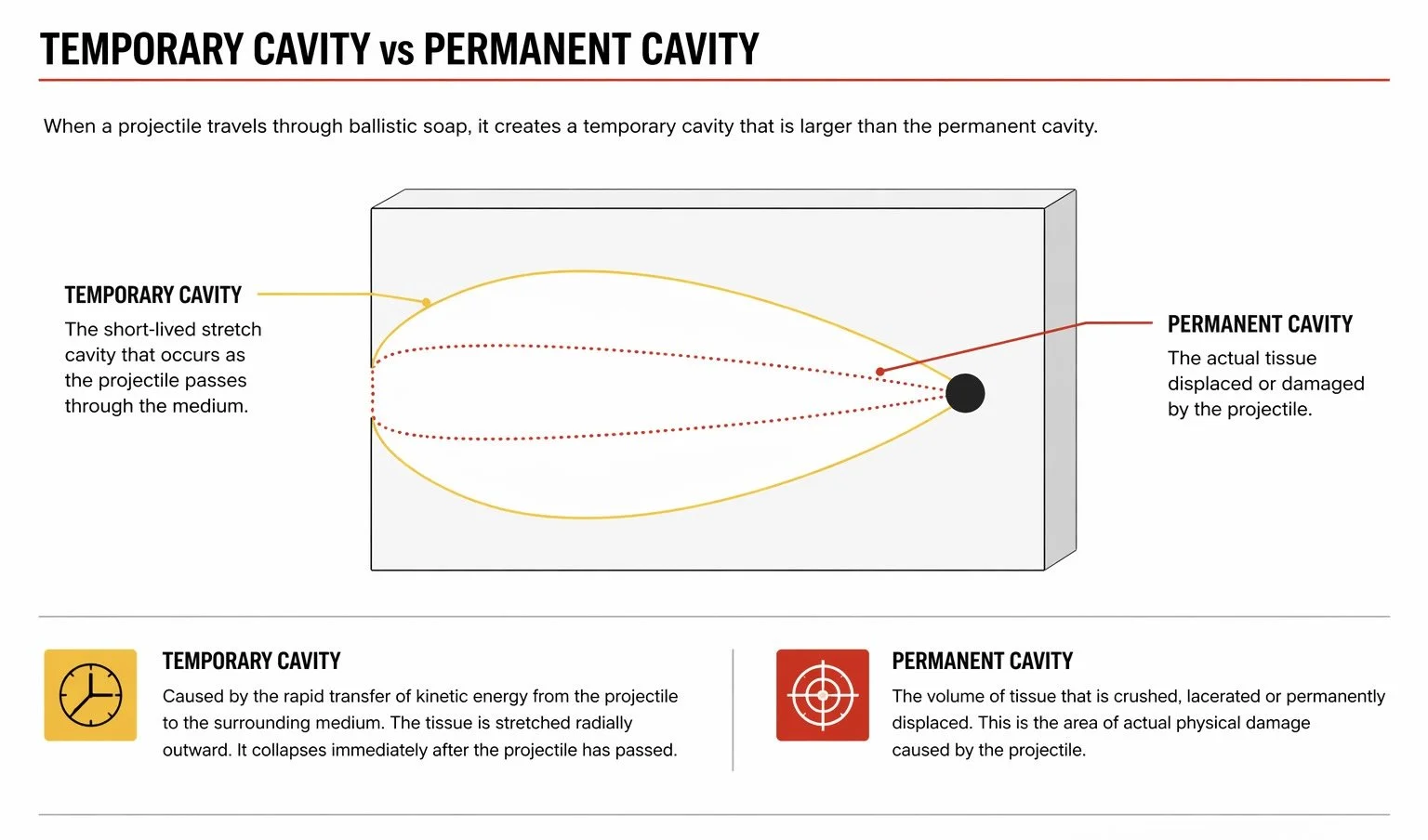
Temporary Cavity

Permanent Cavity

Expansion, deformation and fragmentation
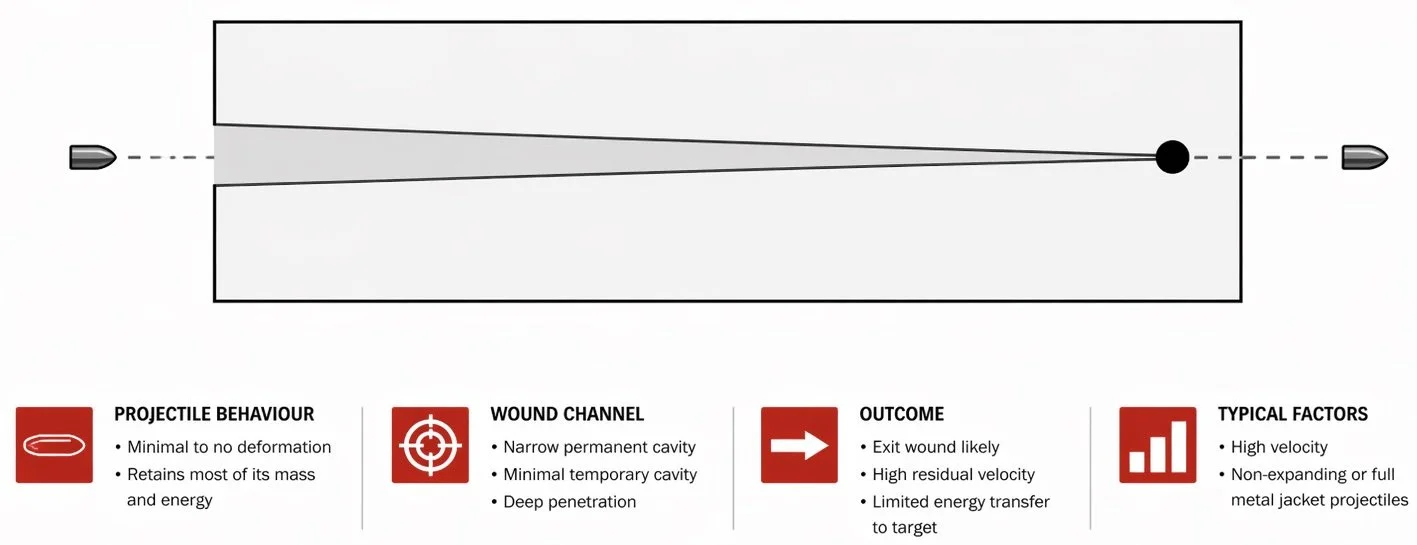
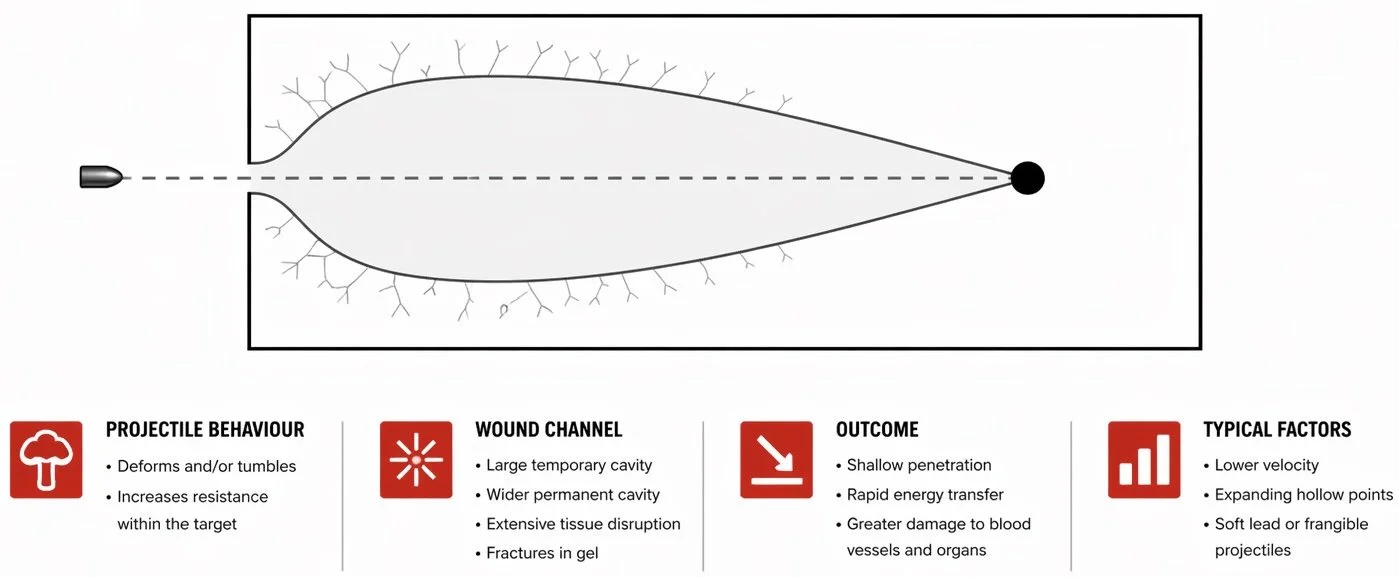
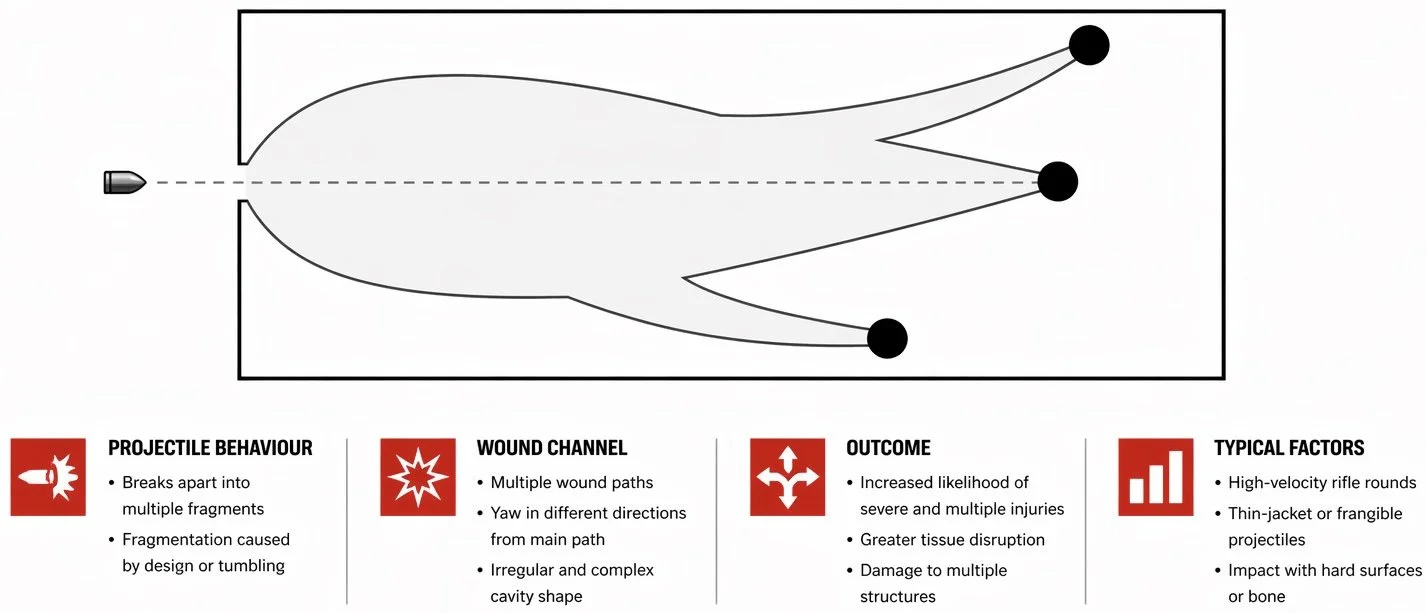
Different projectile behaviours produce recognisably different wound paths and cavity patterns. The diagrams below should be interpreted together with penetration depth, retained mass, recovered projectile condition and test velocity.
Low expansion
Low-expansion projectiles deform very little, retain much of their mass and energy, and can produce narrow permanent cavities with deep penetration or exit wounds. A high residual velocity indicates that not all available energy was transferred into the target.
High expansion
High-expansion or tumbling projectiles increase their effective surface area and resistance within the target. This generally creates a wider cavity and more rapid energy transfer, but often reduces penetration depth.
Fragmentation
Some projectiles break into multiple fragments through design, tumbling or impact with a hard structure. The fragments may yaw away from the principal wound track, producing multiple branches and a more complex cavity pattern.
Penetration, cavity and energy analysis
Ballistic soap can be assessed using penetration and cavity analysis in a similar way to ballistic gel. Its plastic deformation characteristic means the temporary cavity remains open rather than collapsing, allowing direct measurement or casting.
Estimated cavity volume
Cut the block along the wound track and measure one half of the cavity, assuming both halves are approximately equal. Measure the cavity height between the two pointed ends and the maximum width between the widest points.
Measure cavity height, h.
Measure maximum width, a.
Square a to obtain a².
Multiply a² by π.
Multiply the result by h.
Divide the final value by 3.
Water-volume method
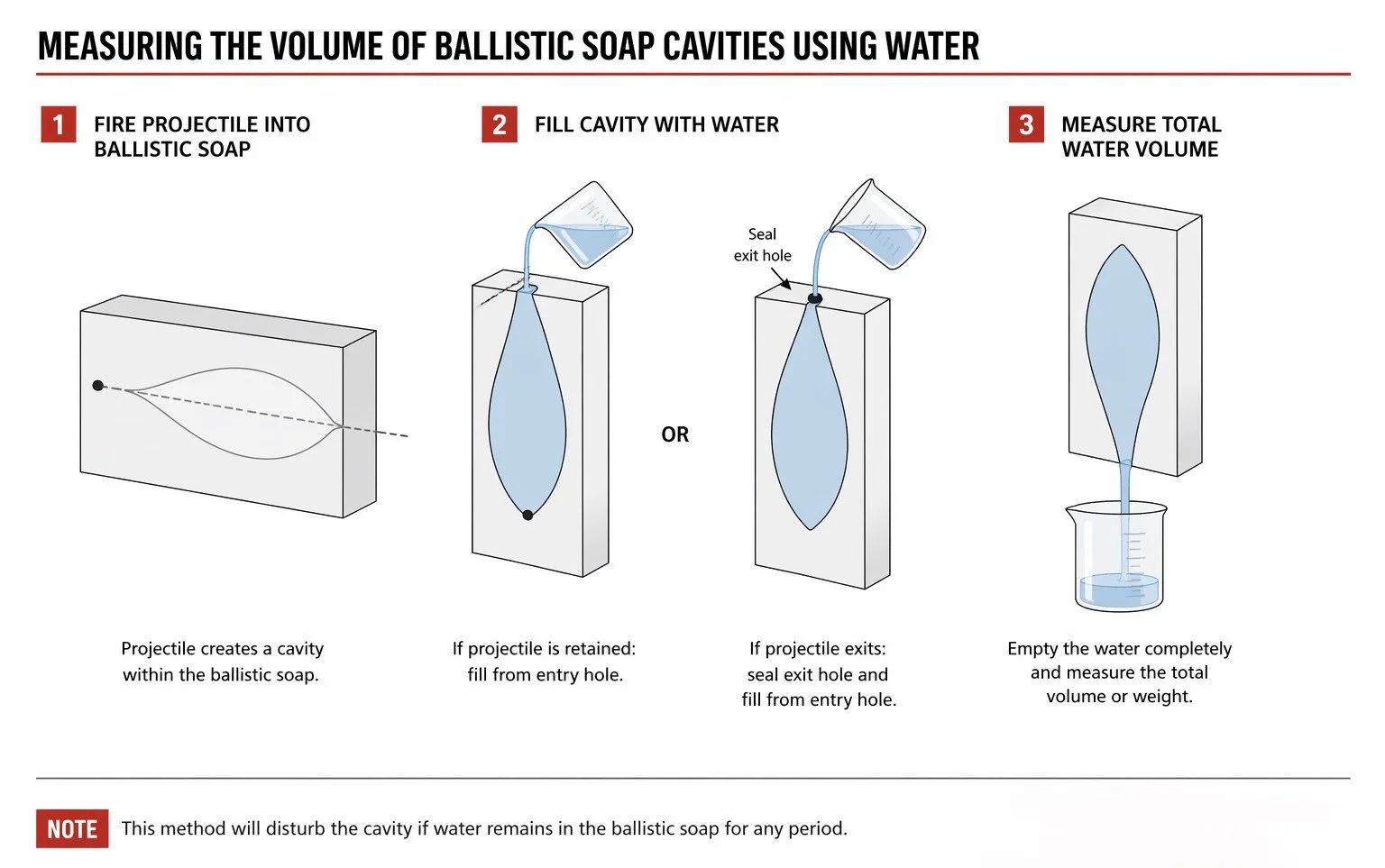
Turn the block upright and temporarily fill the cavity with water. If the projectile exited, seal the exit before filling from the entry. Empty the water completely into a measuring vessel and record its volume or weight.
Casting-volume method
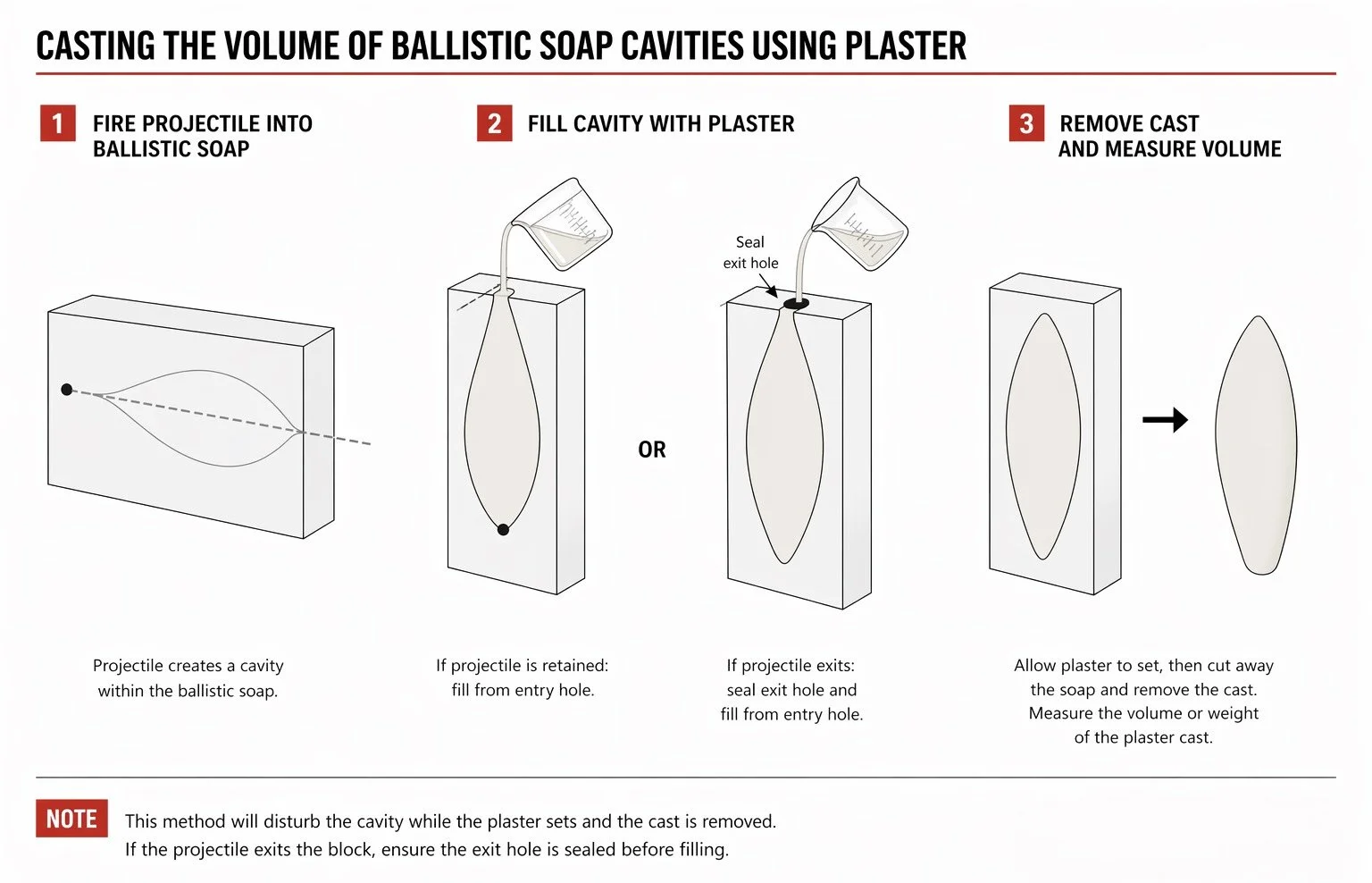
Fill the sealed cavity with a suitable casting material. Once set, cut away the soap, remove the cast and measure its volume or weight. This provides a durable three-dimensional record of the cavity.
Estimated energy transfer
After measuring cavity volume in cubic centimetres, the original page uses an approximate conversion of cavity volume multiplied by three to estimate transferred energy. Where the projectile exits the block, the result represents only the energy deposited within the captured media. For more complete measurement, place a second block behind the first and repeat the analysis for both cavities.
Bloodstain patterns and bone hydraulics
Bloodstain pattern analysis
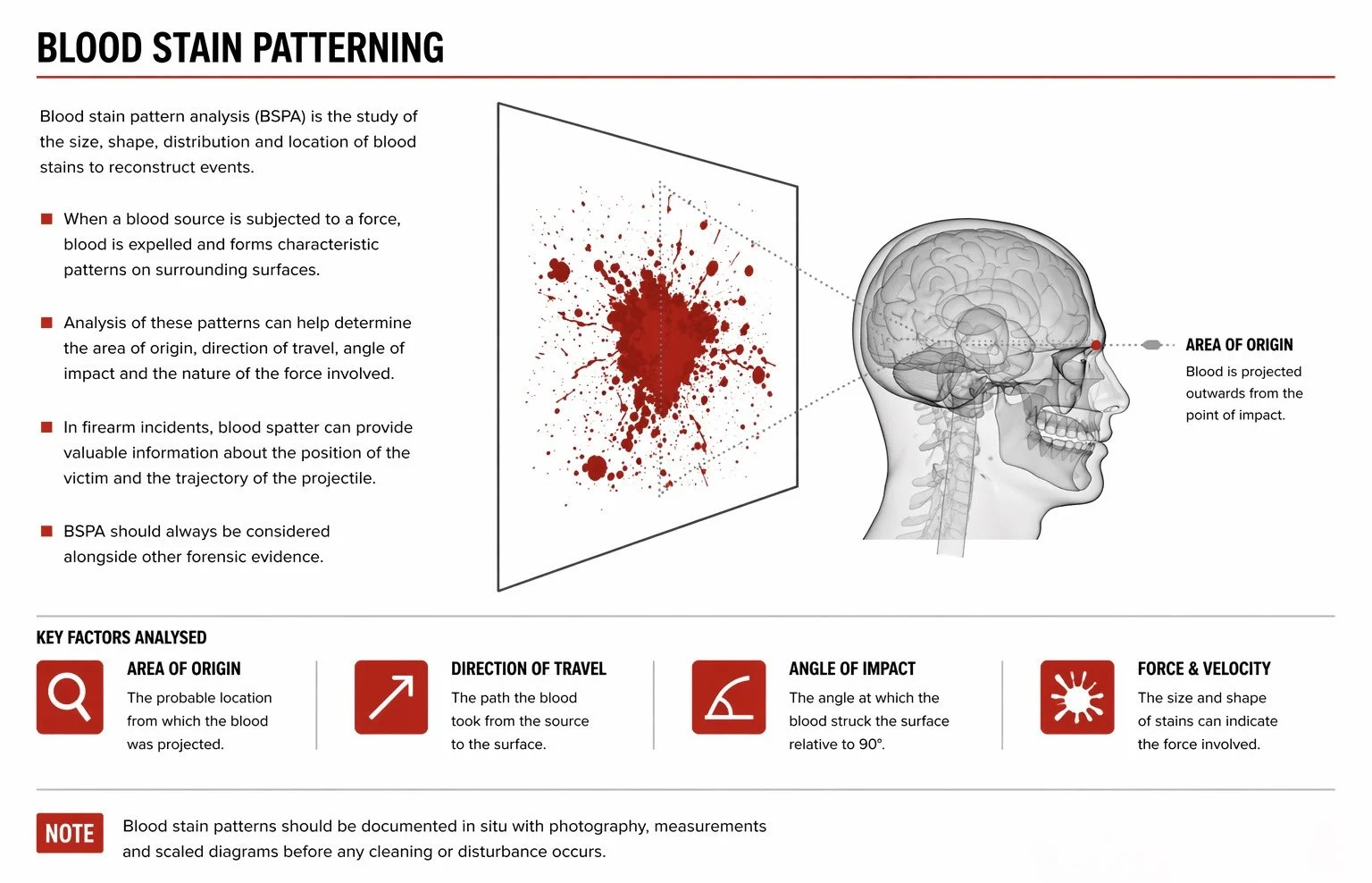
Bloodstain pattern analysis examines the size, shape, location and distribution of stains to help reconstruct an event. In ballistic testing, simulated blood systems can produce both forward spatter and back spatter, allowing controlled reference tests at known distances and angles.
- Assess stain location, size, shape and distribution.
- Examine droplet form, including roundness, elongation and edge feathering.
- Analyse impact angle and direction of travel.
- Consider the overall concentration and spread of the pattern.
- Compare against reference tests conducted under controlled conditions.
Bone hydraulics
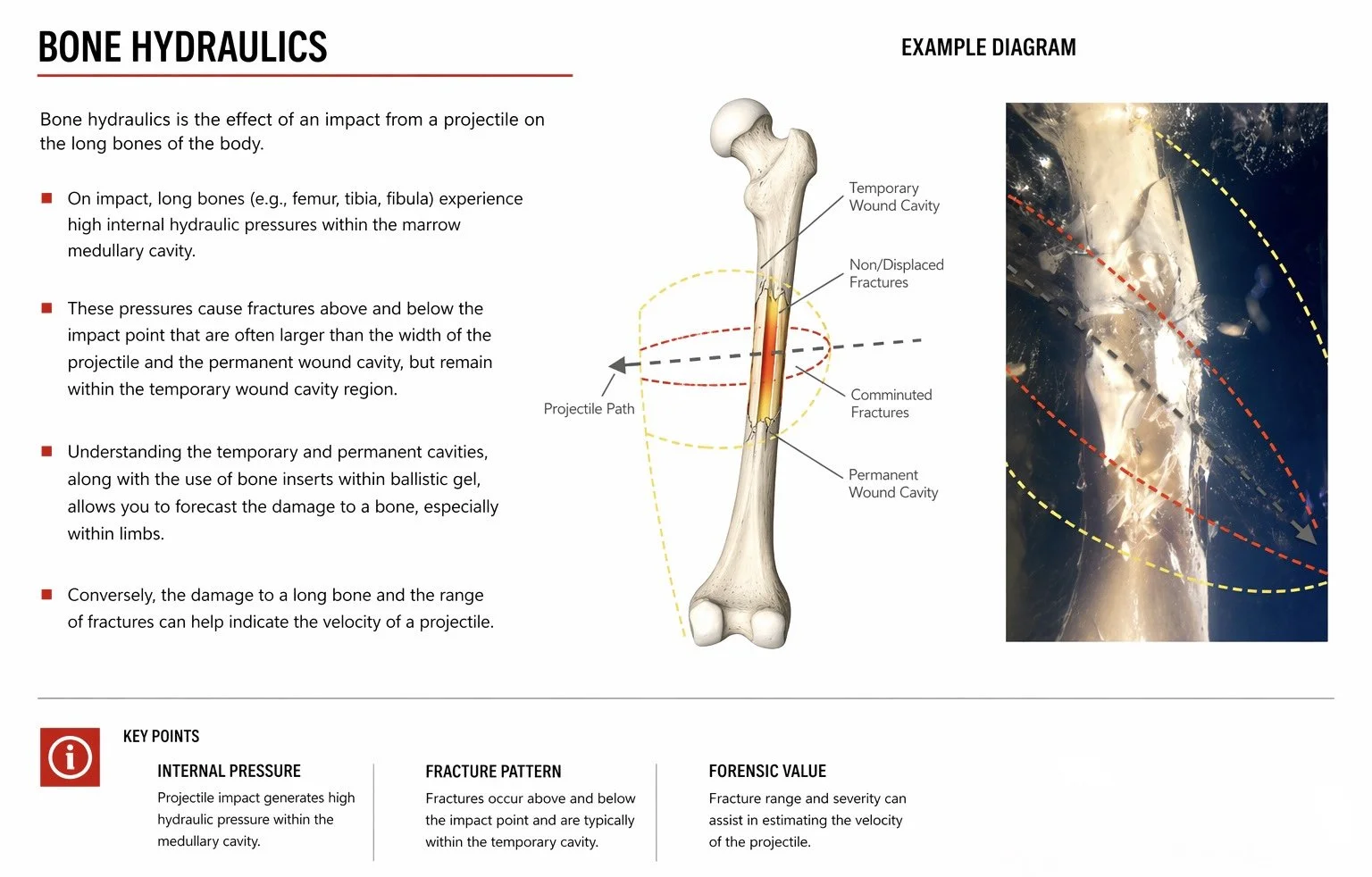
Long bones such as the femur, tibia and fibula can experience high internal hydraulic pressure within the medullary cavity during impact. This can produce fracture patterns above and below the direct wound track that extend beyond the projectile diameter and permanent cavity.
Using bone inserts inside ballistic gel helps correlate temporary-cavity development with fracture location. Conversely, the extent and distribution of fractures may assist in estimating projectile behaviour and velocity when interpreted alongside all other evidence.
Build reliable comparative data
The value of any analysis depends on complete and consistent recording. The following fields reflect the information used by the Defensible Ballistics Ballistic Report tool and provide a practical example of the data that should be recorded for every test.
Test identification
- Test reference or numberUnique identifier
- Date and timeWhen the test was conducted
- Operator or organisationPerson responsible
- Observation or notesPurpose, anomalies and context
Ballistic gel block
- Block lengthcm
- Block widthcm
- Block heightcm
- Gel density10% Standard/FBI or 20% NATO
- Product and batchTraceability
- Calibration resultMethod and measured penetration
Test environment and setup
- Gel temperature°C
- Ambient temperature°C
- Humidity%
- Rangem
- Impact angleDegrees and orientation
- Block support and backstopTest arrangement
Projectile details
- Projectile descriptionType, design and manufacturer
- Calibre or nominal diametermm or calibre designation
- Projectile widthmm
- Original projectile weightgrains or grams
- Projectile speedm/s
- Calculated impact energyJ, where required
Wound-path measurements
- Total wound-path length (L)Full projectile path, cm
- Cavity start point (d)Depth where radial fractures begin, cm
- Cavity length (c)Length over which cavity continues, cm
- Maximum cavity width (w)Widest cavity or fracture extent, cm
- Exit point or final positionLocation and orientation
- Fragment pathsNumber, direction and depth
Recovered projectile data
- Projectile recovered?Yes, no or partial
- Recovered projectile weightgrains or grams
- Projectile weight retention% of original weight
- Recovered diameterMaximum expanded width, mm
- Recovered lengthmm
- ConditionExpanded, deformed, tumbled or fragmented
Calculated and reported results
- Estimated temporary-cavity volumecm³
- Estimated energy transferJ
- Penetration as block percentage% of block length
- Projectile expansion ratioRecovered ÷ original diameter
- Photographic referencesEntry, exit, side and sectioned views
- Video or chronograph filesAssociated evidence references
Comparative controls
- Units and measurement methodKeep consistent across tests
- Photography scaleVisible measurement reference
- Camera position and lightingRepeatable documentation
- Control or previous test referenceComparison dataset
- Deviations from procedureRecord every variation
Projectile weight retention
Weight retention records how much of the original projectile mass remains in the recovered projectile or collected fragments. Use the same unit for both measurements and include all fragments that can be reliably attributed to the projectile.
Analysis support
Should penetration and cavity measurements be interpreted separately?
No. Penetration, cavity geometry, fracture pattern, projectile behaviour and test conditions should be assessed together.
Why use a second block?
A second block can capture additional penetration and energy transfer where the projectile exits the first block.
Which soap-volume method preserves the cavity best?
Cut-and-measure can preserve the overall block form more effectively, while water and casting methods directly quantify internal volume but may disturb the cavity.
How important is calibration?
Calibration is essential for meaningful comparison. Results from media with different density, temperature or calibration cannot be treated as directly equivalent.
What should photographs include?
Include an identification reference, measurement scale, orientation and views showing entry, exit, wound path and cavity dimensions.
Need support interpreting a ballistic test?
Provide the test medium, calibration, projectile details, velocity, distance, photographs and measurements so the Defensible Ballistics team can understand the scope of your enquiry.