

Medical Phantoms: What They Are and How They Are Used?
Introduction
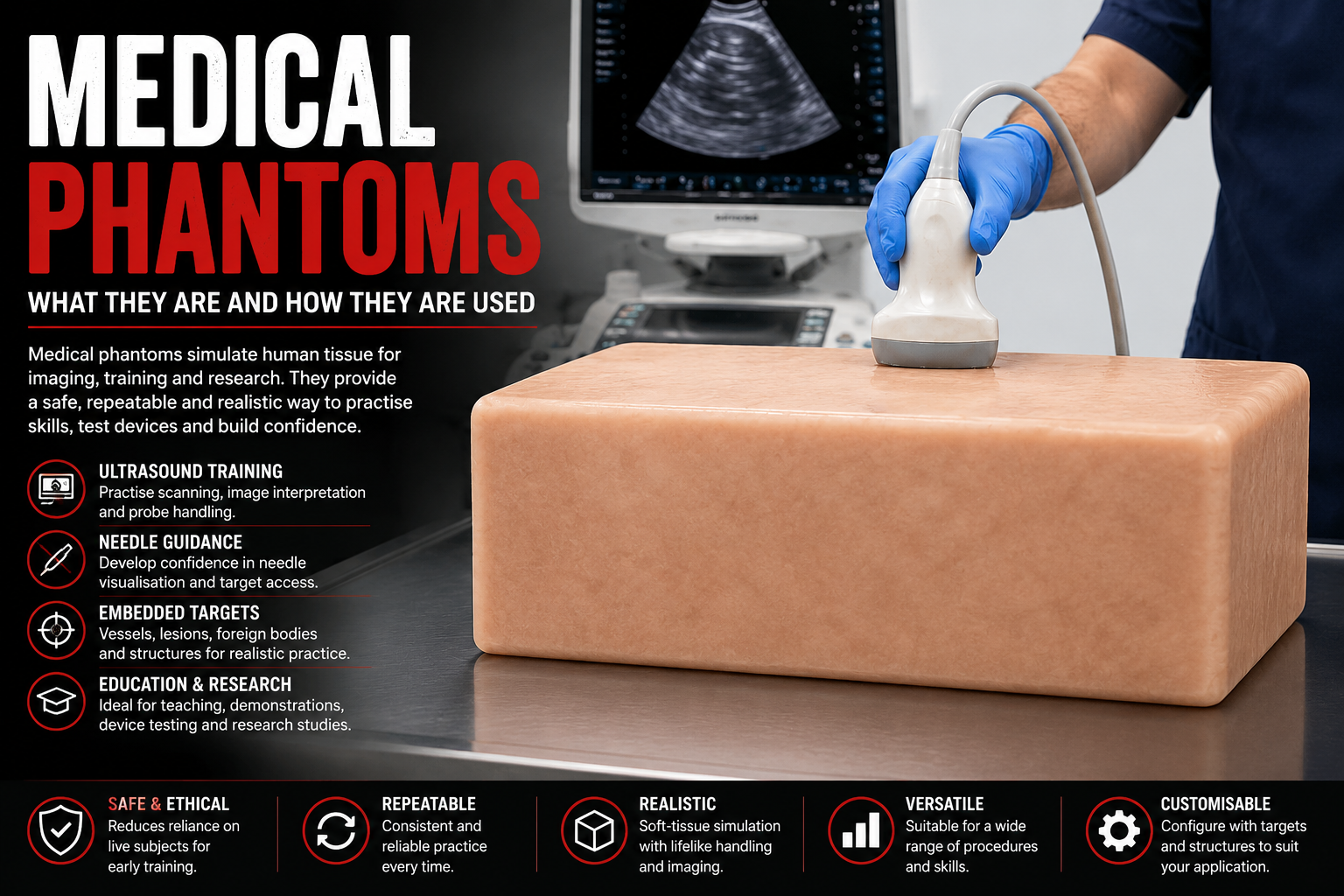
Medical phantoms are specialist training and testing models used to simulate parts of the human body.
They are commonly used in medical education, imaging research, ultrasound training, procedural practice and device development. A phantom can provide a controlled, repeatable and realistic training medium without the need to use a patient.
At Defensible Ballistics, we supply gel-based testing and simulation materials, including medical phantom products through Acousim, designed to support training, research and visual demonstration.
What is a medical phantom?
A medical phantom is a model that simulates tissue, anatomy or a specific clinical target.
The purpose of a phantom is to give users something realistic and repeatable to scan, image, puncture, measure or test. Depending on the design, a phantom may contain soft gel, embedded targets, simulated vessels, bone inserts, foreign body targets or other structures.
Medical phantoms can be used to help practise or demonstrate:
Ultrasound scanning
Needle guidance
Procedural skills
Imaging visibility
Target identification
Device testing
Research methods
Training scenarios
In simple terms, a medical phantom gives users a controlled model for learning, testing and improving technique.
Why are medical phantoms used?
Medical phantoms are used because they provide a safe and repeatable training medium.
In medical training, it is important to practise skills before performing them in real clinical settings. A phantom allows trainees, researchers and professionals to build confidence, repeat procedures and compare results in a controlled environment.
Medical phantoms are useful because they can:
Reduce reliance on live subjects for early training
Provide repeatable practice
Support teaching and demonstration
Help users understand imaging appearances
Allow comparison between techniques
Support device development
Provide a realistic soft-tissue simulation
Improve confidence before clinical application
Medical phantoms for ultrasound training
Ultrasound phantoms are commonly used to help users practise probe handling, image interpretation and needle guidance.
A well-designed ultrasound phantom allows the user to scan through a soft medium and identify embedded targets or structures. This helps trainees understand how angle, pressure, depth and probe position affect the image.
Ultrasound phantoms may support training in:
Probe control
Image optimisation
Target identification
Needle tracking
Hand-eye coordination
Depth judgement
Procedural planning
Repeated scanning practice
This makes them useful for universities, hospitals, simulation centres, research teams and training providers.
Medical phantoms for needle guidance
Needle guidance is a skill that benefits from repeated practice.
A phantom allows the user to practise guiding a needle towards a target while observing the needle path under imaging. This can help develop hand control, spatial awareness and confidence.
Needle guidance phantoms may be used for:
Ultrasound-guided procedures
Target practice
Foreign body localisation
Biopsy-style training
Injection practice
Procedural simulation
Education and assessment
The key benefit is that users can repeat the task multiple times in a controlled training environment.
Medical phantoms for research
Medical phantoms are also useful in research because they provide a consistent medium for testing ideas, techniques or devices.
Researchers may use phantoms to compare imaging settings, test new equipment, evaluate target visibility or develop training models.
A phantom can be useful for research involving:
Ultrasound imaging
MRI or X-ray visibility
Needle guidance
Device testing
Insert design
Target detection
Simulation material development
Repeatable test methods
Because the phantom can be designed with known features, it gives researchers a controlled model for comparison.
Medical phantoms for education
Medical phantoms are useful in education because they make practical skills easier to teach.
Instead of only explaining a procedure in theory, instructors can use a phantom to demonstrate technique, show imaging appearances and allow students to practise repeatedly.
Medical phantoms may be used in:
Universities
Medical schools
Simulation centres
Clinical skills labs
Training courses
Research laboratories
Professional development sessions
They can support hands-on learning and help bridge the gap between theory and clinical practice.
Why gel-based materials are useful
Gel-based materials are useful for medical phantoms because they can provide a soft, tissue-like feel and can be formed into different shapes.
Depending on the design, gel materials can also hold embedded targets or inserts. This allows a phantom to be configured for a specific training or research purpose.
Gel-based phantom materials can support:
Soft-tissue simulation
Imaging practice
Needle guidance
Embedded targets
Custom shapes
Repeatable training
Visual demonstrations
Research models
The right gel formulation depends on the intended use, imaging requirements and training objective.
Synthetic gel for phantom applications
Synthetic gel can be useful in phantom applications because it can offer consistency, reusability and practical handling.
At Defensible Ballistics, synthetic ballistic gel is used across a range of testing and simulation applications. In medical and training contexts, gel-based materials can support soft-tissue simulation, imaging phantoms and custom model development.
Synthetic gel materials may be useful where customers need:
A consistent soft medium
Configurable phantom designs
Embedded targets
Reusable or repeatable training models
Custom shapes
Visual demonstration
Research-friendly materials
Synthetic Ballistic Gel for Medical Imaging and Training Phantoms
What can be placed inside a medical phantom?
Depending on the design, medical phantoms can contain a range of inserts or targets.
These may include:
Simulated vessels
Small target spheres
Needles or tracks
Bone inserts
Foreign body targets
Tubes
Cavities
Marker objects
Layered materials
Custom inserts
The insert choice depends on what the phantom is designed to teach or test.
Phantom blocks
A phantom block is a simple and practical format for medical simulation.
A rectangular block can be used for scanning, imaging, target detection and needle guidance. The simple shape makes it easy to place on a table, store, transport and use in teaching sessions.
Phantom blocks are useful because they are:
Easy to handle
Easy to scan
Suitable for embedded targets
Practical for training
Repeatable for research
Suitable for demonstrations
Simple to document and photograph
Medical phantoms and ballistic gel materials
Although medical phantoms and ballistic gel products are used in different settings, they share some important material requirements.
Both may require a controlled soft medium, consistency, repeatability and the ability to support visual or imaging analysis.
For example, ballistic gel is often used to observe impact behaviour and wound paths, while medical phantoms may be used to observe imaging targets and needle paths. In both cases, the gel material helps create a controlled model for testing and demonstration.
This is why gel-based materials can be useful across forensic, research, training and medical simulation applications.
Choosing the right medical phantom
The right phantom depends on the intended application.
Before choosing a phantom, consider:
What procedure or skill is being trained?
What imaging method will be used?
Does the phantom need embedded targets?
Does it need to be needle-compatible?
Does it need to simulate vessels or foreign bodies?
Does it need to be reusable?
Does it need to be transparent or opaque?
What size and shape is required?
Will it be used for teaching, research or demonstration?
These questions help define the best phantom design.
Common mistake: choosing a phantom without defining the training aim
A common mistake is choosing a phantom before deciding what it needs to teach.
A phantom for ultrasound target detection may need different inserts from a phantom designed for needle guidance. A research phantom may need more controlled and measurable features than a general training block.
The clearer the training aim, the better the phantom can be matched to the task.
Common mistake: overlooking repeatability
Repeatability is important in both training and research.
If a phantom is used to compare techniques, devices or results, the structure and material should be consistent. This helps ensure the comparison is meaningful.
For training, repeatability also means students can practise the same task multiple times under similar conditions.
Common mistake: treating every phantom as the same
Medical phantoms vary widely.
Some are simple blocks. Others contain targets, vessels, layered structures, bone inserts or other features. Some are designed for imaging, while others are designed for procedural practice.
Before choosing a phantom, it is important to understand what it is designed to simulate.
Summary
Medical phantoms are specialist models used for imaging, training, research and procedural practice.
They provide a controlled and repeatable way to practise skills, test equipment, demonstrate techniques and support education. Gel-based phantom materials can simulate soft tissue, hold embedded targets and support imaging or needle guidance applications.
At Defensible Ballistics, our wider gel expertise supports medical phantom applications through Acousim, including configurable phantom products for training, research and demonstration.
Explore medical phantom materials
Defensible Ballistics supplies gel-based testing materials and medical phantom products for education, imaging, research and training applications.
Browse our medical phantom range to choose the right model for your project.