

Lead-Free Ammunition Testing: Why Ballistic Gel Matters
Introduction
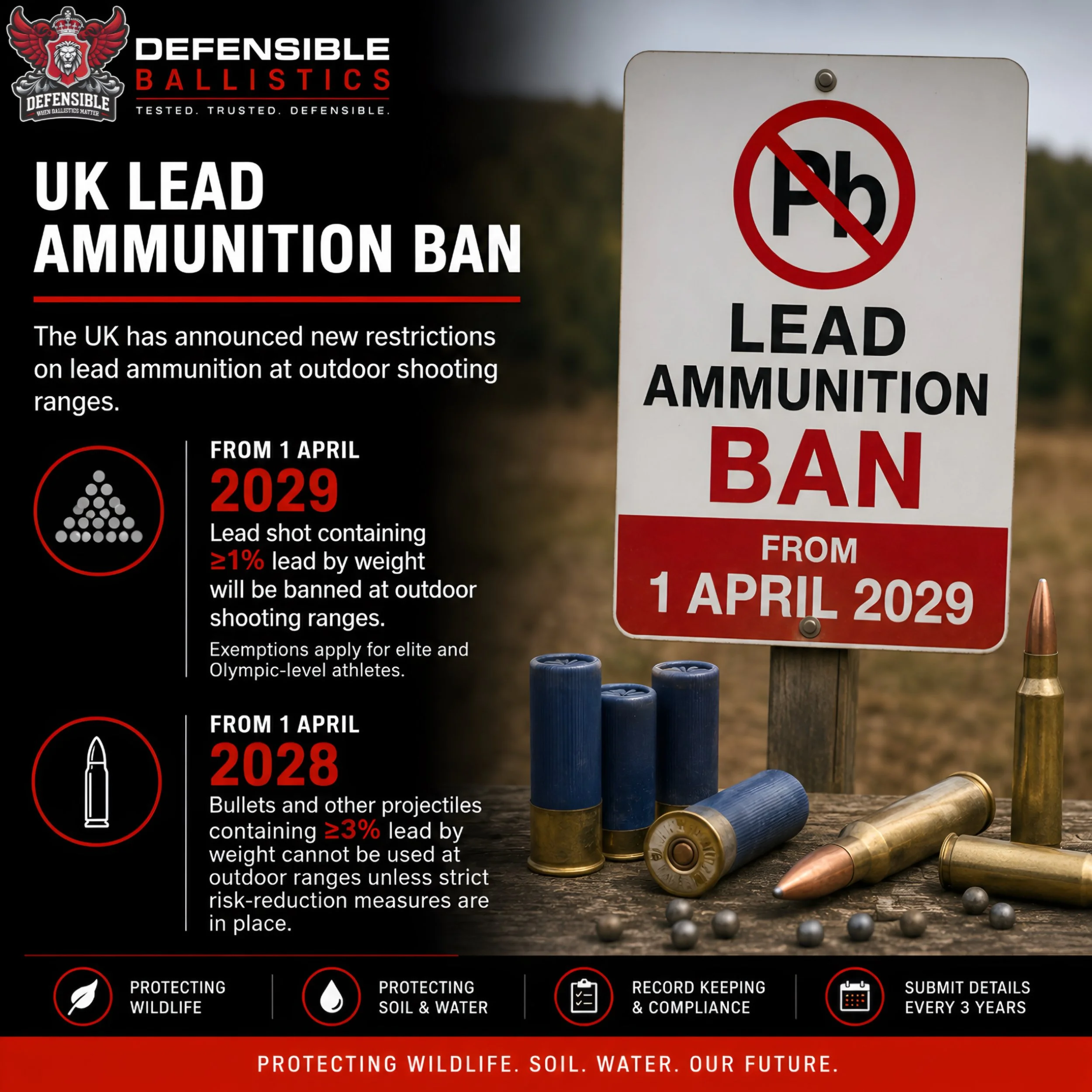
As lead-free ammunition becomes increasingly important across the UK (with a lead ban from April 2028) and Europe, understanding real-world projectile performance has never been more valuable.
Shooters, researchers, manufacturers and professionals need reliable ways to compare how different projectiles behave after impact. Ballistic gel provides a controlled and repeatable testing medium that can help visualise penetration, expansion, fragmentation and energy transfer.
At Defensible Ballistics, our calibrated ballistic media helps users see what really happens on impact.
Why lead-free ammunition testing matters
Lead-free ammunition is becoming more widely discussed and used across sporting, professional and environmental contexts.
However, lead-free projectiles are not all the same. Different materials, shapes and designs can produce different results. Some lead-free ammunition may perform similarly to traditional lead-based rounds, but projectile design plays a major role.
This is why testing matters.
A controlled test medium can help users compare how different projectiles behave under similar conditions.
What ballistic gel can show
Ballistic gel is useful because it makes projectile behaviour visible.
When a projectile enters the gel, the path through the material can help show how energy is transferred and how the projectile performs after impact.
Ballistic gel can help compare:
Penetration depth
Expansion
Fragmentation
Temporary cavity behaviour
Permanent wound path
Retained mass
Direction of travel
Overall terminal performance
This makes ballistic gel a practical tool for comparing lead-free and traditional projectile designs.
Penetration depth
Penetration depth is one of the most important factors to observe when comparing ammunition.
A projectile that penetrates too little may not perform as intended. A projectile that penetrates deeply may retain more forward momentum or expand differently depending on its design.
Ballistic gel allows users to measure and compare penetration depth in a consistent medium.
This is especially useful when comparing:
Lead-free projectiles
Traditional lead-based rounds
Different bullet weights
Different bullet designs
Different impact velocities
Different test distances
Expansion and deformation
Projectile expansion can have a significant effect on terminal performance.
Some projectiles are designed to expand on impact. Others may deform, fragment or retain their shape depending on their construction.
Ballistic gel can help show whether a projectile:
Expands consistently
Deforms unevenly
Remains stable
Tumbles
Fragments
Retains its structure
With lead-free ammunition, design is especially important because different materials may behave differently on impact.
Fragmentation
Fragmentation occurs when parts of the projectile separate during or after impact.
Some projectiles are designed to fragment. Others are designed to retain mass and stay together. Ballistic gel can help show whether fragmentation occurs and where fragments travel within the test medium.
This can be useful for comparing different projectile designs and understanding how energy is distributed through the gel.
Temporary and permanent cavities
When a projectile passes through ballistic gel, it can create both temporary and permanent cavity effects.
The temporary cavity is the movement or stretching of the surrounding material during impact.
The permanent cavity is the visible wound path or disruption left behind after the projectile has passed through.
Ballistic gel helps users observe and compare these effects, especially when using transparent synthetic gel or when recording the test with photography or video.
Retained mass
Retained mass refers to how much of the projectile remains after impact.
For some testing, it can be useful to recover the projectile or fragments and compare their weight before and after impact. This can help users understand how much material was retained, lost or fragmented.
When comparing lead-free ammunition, retained mass can be a useful part of the overall performance picture.
Overall terminal performance
Terminal performance is not based on one factor alone.
Penetration, expansion, fragmentation, cavity formation and retained mass all contribute to the overall result. Ballistic gel allows these factors to be observed together in a controlled testing medium.
This helps users compare not only whether a projectile reached a certain depth, but also how it behaved throughout the impact.
Why controlled testing matters
For meaningful comparison, the test needs to be controlled.
If the gel density, block size, distance, temperature or setup changes between tests, the results may be harder to interpret.
A good comparison should try to keep the following consistent:
Gel type
Gel density
Block size
Test distance
Shot placement
Projectile type
Impact angle
Environmental conditions
Recording method
The more consistent the test setup, the more useful the comparison becomes.
Why calibration matters
Calibration is important because ballistic gel is used as a comparison medium.
If the gel is too soft, too firm or inconsistent, the results may be misleading. A calibrated gel helps provide a known and repeatable testing medium.
This is especially important when comparing lead-free ammunition against traditional projectiles, or when comparing different lead-free designs.
Defensible Ballistics synthetic ballistic gel is supplied calibrated in different density options, including 10% forensic/FBI-style density and 20% NATO-style density.
10% vs 20% ballistic gel for ammunition testing
Different gel densities can produce different results.
10% ballistic gel is softer and commonly used for forensic/FBI-style testing, demonstrations and comparison work.
20% ballistic gel is firmer and commonly used for NATO-style testing or where a denser, more resistant medium is required.
When testing ammunition, it is important to choose the correct density for the purpose of the test and to avoid directly comparing results from different densities without explaining the difference.
Synthetic ballistic gel for visual comparison
Synthetic ballistic gel is useful for ammunition testing because it is transparent, calibrated and reusable when handled correctly.
The transparency allows users to see the wound path inside the block. This helps with photography, video, measurement and side-by-side comparison.
Synthetic ballistic gel can help users observe:
Penetration depth
Projectile path
Expansion behaviour
Fragment paths
Cavity shape
Final projectile position
For repeated testing, synthetic gel can also be melted and recast when handled correctly.
Ballistic soap for preserved cavity analysis
Ballistic soap can also be useful when testing ammunition.
Unlike gel, which may close back around the wound path, ballistic soap can preserve the cavity more clearly after impact. This makes it useful for post-impact inspection, photography and comparison work.
Ballistic soap may be useful when the priority is:
Cavity preservation
Post-impact analysis
Photography
Visual comparison
Demonstration
Documentation
Lead-free ammunition and projectile design
Research and practical testing both show that projectile design makes a significant difference.
Lead-free ammunition is not a single category with one predictable result. Performance can vary depending on the projectile material, construction, shape, weight and intended use.
Some lead-free projectiles may expand and penetrate in a similar way to traditional lead-based rounds. Others may behave differently.
Ballistic gel helps users move beyond assumptions by showing the actual behaviour of a projectile in a controlled medium.
Useful testing observations
When testing lead-free ammunition in ballistic gel, useful observations may include:
Did the projectile expand?
Did it fragment?
How deep did it penetrate?
Was the wound path straight or angled?
Where did the main energy transfer appear to occur?
Was the projectile recovered?
How much mass was retained?
How did the result compare with another projectile?
Was the test repeated under the same conditions?
Recording these observations makes the test more useful.
Documentation and photography
Good documentation helps turn a test into useful information.
When testing ammunition, it can be helpful to record:
Ammunition type
Projectile weight
Projectile construction
Gel type and density
Block size
Test distance
Impact angle
Temperature and conditions
Photographs before and after
Video where possible
Penetration depth
Recovered projectile condition
Retained mass where measured
Clear records make it easier to compare results later.
Common mistake: assuming all lead-free ammunition performs the same
A common mistake is treating all lead-free ammunition as one category.
Different lead-free projectiles can behave very differently. Some may expand, some may fragment, and some may retain their shape more strongly. The only reliable way to understand the behaviour is to test and compare under controlled conditions.
Common mistake: comparing results from different setups
Another common mistake is comparing results from different tests without controlling the conditions.
A projectile tested in 10% gel at one distance should not be directly compared with another projectile tested in 20% gel at a different distance unless the differences are clearly explained.
For better comparison, keep the setup consistent.
Common mistake: focusing only on penetration depth
Penetration depth is important, but it is not the only factor.
A useful test should also consider expansion, deformation, fragmentation, cavity shape, retained mass and the overall wound path.
Ballistic gel helps show the full picture.
Summary
As lead-free ammunition becomes more important across the UK and Europe, controlled testing is increasingly valuable.
Ballistic gel provides a practical way to compare projectile performance, including penetration depth, expansion, fragmentation, cavity formation, retained mass and overall terminal behaviour.
Lead-free ammunition can perform similarly to traditional lead-based rounds in some cases, but projectile design makes all the difference. Calibrated ballistic media helps users visualise and compare what really happens on impact.
Explore ballistic media for ammunition testing
Defensible Ballistics supplies calibrated synthetic ballistic gel, natural ballistic gel, ballistic soap, gel chips and moulds for testing, research, demonstration and professional applications.
Browse the product range to choose the right testing medium for your ammunition testing project.