

Ballistic Gel and Blast Protection Research
Introduction
Ballistic gel is not only used for ammunition testing. It can also support research into protection against explosive threats such as land mines, improvised explosive devices and blast-related fragmentation.
By providing a controlled soft-tissue simulant, calibrated ballistic gel allows researchers, engineers and product developers to study how blast energy, fragments and protective materials interact with the human body.
At Defensible Ballistics, our calibrated ballistic media supports research, testing, training and product development across defence, forensic and medical sectors.
Why ballistic gel is useful for blast protection research
Blast protection research often involves understanding how explosive forces transfer energy into the body.
Real-world blast injuries can be complex. They may involve pressure waves, high-speed fragments, ground shock, debris, impact trauma and energy transfer through protective equipment.
Ballistic gel helps researchers visualise and compare some of these effects in a controlled test medium.
It can be used to support research into:
Blast wave effects
Fragment penetration
Lower limb trauma
Temporary cavity formation
Permanent wound paths
Energy transfer through protective materials
Protective footwear performance
Armour system effectiveness
Medical response training
Human tissue simulation
Simulating soft tissue in controlled testing
Ballistic gel is commonly used as a soft-tissue simulant.
It does not fully recreate the human body, but it provides a consistent medium that can help demonstrate how energy and fragments interact with soft tissue-like material.
For blast protection research, this can be useful because the gel allows researchers to observe internal effects that may not be visible from the outside.
Depending on the test setup, ballistic gel may help show:
How far fragments travel
How energy is transferred into the material
How temporary cavities form
How protective layers change the result
Whether fragments are slowed, stopped or redirected
How different materials compare under similar conditions
Blast wave effects
Explosive events can create pressure waves that interact with the body and surrounding materials.
While ballistic gel cannot reproduce every aspect of a real blast environment, it can be used as part of a controlled test setup to help study how soft materials respond to sudden energy transfer.
In research settings, gel may be combined with high-speed imaging, sensors, protective layers or specialist test rigs to help demonstrate the effect of blast-related forces.
This can support a better understanding of how protective systems behave under controlled conditions.
Fragment penetration
Fragments are a major concern in many blast-related incidents.
Fragments may come from the explosive device itself, surrounding materials, vehicle components, ground debris or secondary objects. These fragments can travel at high speed and cause serious injury.
Ballistic gel can help researchers study fragment penetration by showing:
Entry points
Penetration depth
Fragment paths
Cavity formation
Direction changes
Fragment distribution
The effect of protective barriers
This makes ballistic gel useful for comparing materials and protective systems intended to reduce fragment injury.
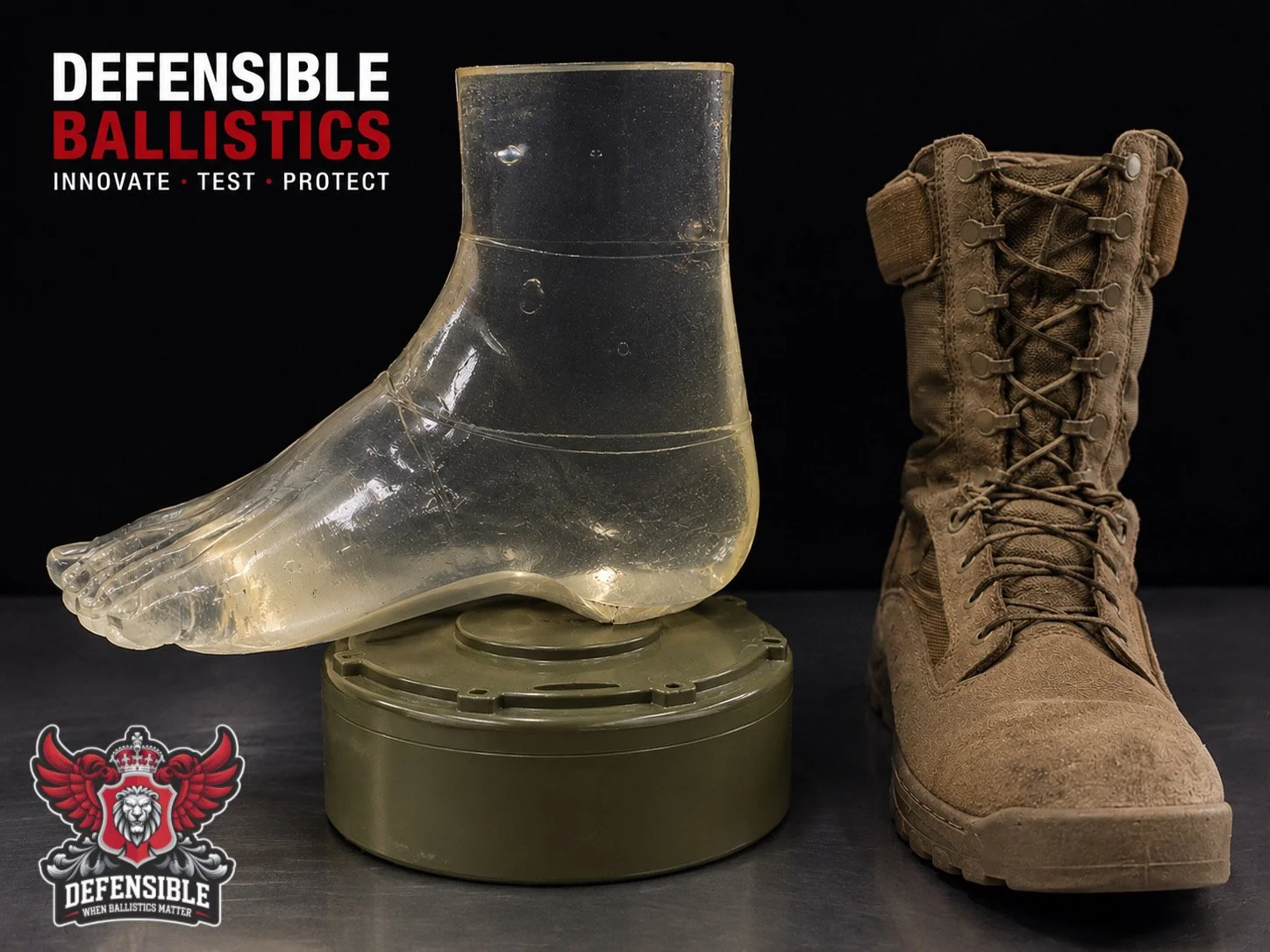
Lower limb trauma from mines and IEDs
Lower limb injuries are a major area of concern in blast protection research, particularly in relation to land mines and improvised explosive devices.
When an explosive force acts from below, energy can transfer through the ground, footwear, vehicle floor or protective equipment into the foot, ankle and leg.
Ballistic gel can support lower limb research by helping simulate soft tissue response in controlled tests. It may be used alongside anatomical inserts, bone simulants, footwear, protective materials or specialist fixtures depending on the research aim.
This can help researchers and engineers better understand how protective systems affect energy transfer.
Testing military boots and protective footwear
Blast-resistant footwear and military boots are designed to help reduce injury risk in extreme environments.
Ballistic gel can be used as part of testing and development to help assess how energy is transferred through footwear and into a soft-tissue simulant.
Testing may consider:
Sole construction
Material layering
Energy absorption
Fragment resistance
Deformation under impact
Pressure distribution
Lower limb protection concepts
The goal is not simply to stop visible damage, but to understand how much force or energy may still be transmitted through the protective system.
Vehicle floor protection
Vehicles operating in hazardous environments may require floor protection against blast threats.
Ballistic gel can support research into how blast forces or fragments may transfer through vehicle floor systems and into occupants.
In controlled testing, gel may be used to help compare:
Floor materials
Layered protection systems
Energy-absorbing structures
Fragment mitigation designs
Occupant protection concepts
Underbody protection approaches
This can help designers evaluate how protective structures behave and identify areas for improvement.
Body armour systems and protective materials
Ballistic gel is also useful when assessing body armour systems and protective materials.
When placed behind protective layers, gel can help show whether energy, deformation or fragments are transferred into the soft-tissue simulant.
This can support testing involving:
Armour panels
Layered protective materials
Helmets
Shields
Soft armour systems
Hard armour systems
Protective clothing
Specialist PPE
The gel helps provide a visual and measurable backing material for comparison.
Temporary and permanent cavities
One of the advantages of ballistic gel is that it can help demonstrate both temporary and permanent cavity effects.
The temporary cavity is the movement or displacement of the gel during the impact event.
The permanent cavity is the visible path or disruption left after the event.
In blast protection research, observing these effects can help researchers understand how energy moves through the material and how different protective systems affect the result.
High-speed imaging can be especially useful for capturing temporary cavity behaviour.
Visualising internal damage
A key benefit of ballistic gel is that it can help make internal effects visible.
External damage alone may not show the full picture. A protective material may appear intact from the outside while still allowing significant energy transfer into the backing medium.
Ballistic gel allows researchers to examine what happened inside the test medium.
This can help demonstrate:
Internal disruption
Cavity formation
Fragment travel
Energy transfer
Material performance
Differences between test setups
Synthetic ballistic gel is especially useful where transparency and visual inspection are important.
Why calibration matters
Calibration is important in blast and protection research because the test medium needs to behave consistently.
If the gel is too soft, too firm or inconsistent, the results may be harder to compare. Calibrated ballistic gel helps provide a known and repeatable medium for testing.
This is important when comparing:
Protective materials
Footwear designs
Armour systems
Vehicle protection concepts
Fragment barriers
Test distances
Blast setups
Different gel densities
A consistent gel medium helps reduce uncertainty in the result.
10% and 20% ballistic gel for protection research
Different gel densities may be used depending on the test requirement.
10% ballistic gel is softer and commonly used for forensic/FBI-style testing, general demonstrations and soft-tissue simulation.
20% ballistic gel is firmer and commonly used for NATO-style testing or where a denser, more resistant medium is required.
For protection research, the correct density depends on the test setup and the type of comparison being made.
Synthetic ballistic gel for repeated testing
Synthetic ballistic gel is useful for research and development because it is transparent, calibrated and reusable when handled correctly.
The transparency allows researchers to see internal effects inside the gel. The reusability allows material to be melted, cast and reused for further testing.
Synthetic ballistic gel may be useful for:
Repeated test programmes
Product development
Training demonstrations
Visual analysis
Photography and video
Controlled comparison testing
Fragment and cavity observation
Ballistic soap for preserved cavity analysis
Ballistic soap can also be useful in blast and protection research.
Unlike gel, which may close back around a wound path, ballistic soap can preserve the cavity more clearly after impact. This can be useful when the priority is post-test inspection, measurement and photography.
Ballistic soap may support:
Preserved cavity analysis
Fragment impact comparison
Post-impact photography
Visual documentation
Demonstration work
Training displays
Medical response training
Blast protection research is not only about equipment design. It can also support medical response training.
Gel-based models and phantoms may be used to help demonstrate injury mechanisms, trauma effects, fragment paths or procedural challenges in a controlled training environment.
This can be useful for:
Trauma training
Emergency response education
Military medical training
Forensic education
Research demonstrations
Scenario-based learning
Medical phantoms and gel-based training models can help users visualise injuries and practise responses without relying on live subjects.
Humanitarian demining and protective equipment
Blast protection research can also support humanitarian demining operations.
Personnel involved in demining may rely on specialist protective equipment, footwear, visors, body protection and tools. Testing and development can help improve equipment design and reduce injury risk.
Ballistic gel can support controlled evaluation of protective systems by helping researchers visualise the effect of fragments, energy transfer and protective barriers.
Product development and material comparison
For manufacturers and engineers, ballistic gel can be a useful product development tool.
It allows different materials, designs and protective systems to be compared under controlled conditions.
This may help with:
Comparing prototype materials
Assessing protective layers
Evaluating footwear designs
Testing armour concepts
Reviewing fragment mitigation
Creating demonstration data
Supporting design refinement
The ability to see and document the result makes ballistic gel valuable throughout the development process.
Importance of controlled testing
Blast and protection testing should be carefully controlled.
Useful comparisons depend on consistent test conditions. This may include:
Gel type
Gel density
Gel block size
Test distance
Fragment type
Protective material
Test angle
Support structure
Environmental conditions
Recording method
High-speed imaging setup
Without consistent testing, results may be harder to interpret.
Documentation and high-speed imaging
High-speed imaging can be especially useful in blast and energy transfer research.
Some effects happen too quickly to see clearly with the naked eye. High-speed cameras can help capture temporary cavity formation, material movement and impact behaviour during the event.
Good documentation may include:
Photographs before and after testing
High-speed video
Gel density
Block size
Protective material details
Fragment or projectile details
Test distance
Impact angle
Measurements
Observations
Recovered fragments or materials
Clear records help make testing more useful for analysis, development and reporting.
Common mistake: treating gel as a complete body substitute
Ballistic gel is a soft-tissue simulant, not a complete human body substitute.
It does not naturally include skin, bone, organs, blood vessels or complex anatomical structures unless those are added as part of a specialist test setup.
Results should therefore be understood as controlled test observations rather than exact real-world injury predictions.
Common mistake: ignoring protective system interaction
When testing protective equipment, it is important to look beyond the surface result.
A protective layer may reduce penetration but still transfer energy into the backing medium. Ballistic gel can help visualise what happens behind the protective material.
This is why backing material, gel density and test setup all matter.
Common mistake: comparing different test setups directly
A result from one blast or fragment test should not be directly compared with another unless the conditions are clearly understood.
Different gel densities, block sizes, distances, fragment types or protective materials can produce different results.
For useful comparison, keep the setup consistent and document all variables.
Summary
Ballistic gel plays an important role in blast protection research by helping researchers and engineers visualise how explosive forces, fragments and protective materials interact with soft-tissue simulants.
It can support research into blast wave effects, fragment penetration, lower limb trauma, protective footwear, vehicle floor protection, body armour systems, medical response training and humanitarian demining equipment.
By using calibrated ballistic media, controlled testing and high-speed imaging, researchers can gain valuable insight into how energy is transferred and how protective systems perform.
At Defensible Ballistics, our calibrated ballistic gel solutions support research, testing, training and product development across defence, forensic and medical sectors.
Explore ballistic gel for blast protection research
Defensible Ballistics supplies calibrated synthetic ballistic gel, natural ballistic gel, ballistic soap, gel chips, moulds and medical phantom materials for testing, research, training and product development.
Browse the product range to choose the right testing medium for your application.