

Ballistic Gel for PPE and Protective Equipment Testing
Introduction
Defensible Ballistics products are not limited to traditional ballistic testing.
Ballistic gel can also be used to support PPE evaluation, product development, training and protective performance analysis. By providing a controlled soft-tissue simulant, ballistic gel allows users to visualise how protective equipment performs during testing.
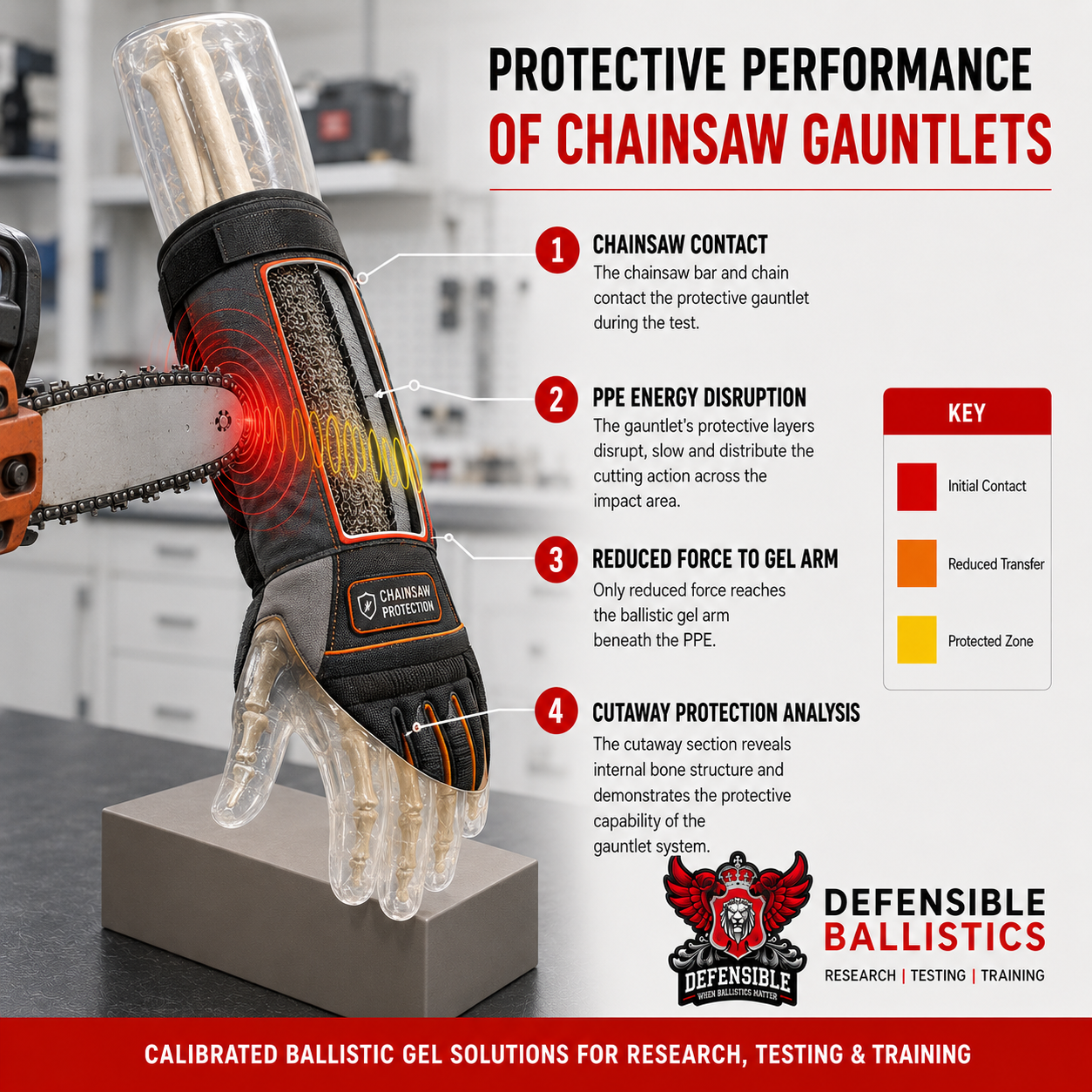
One example is the use of a ballistic gel arm system with visible internal bone structure to demonstrate how a chainsaw protective gauntlet may help disrupt, slow and reduce force before it reaches the arm beneath.
Ballistic gel beyond ammunition testing
Although ballistic gel is often associated with projectile testing, its value comes from its ability to simulate soft tissue in a controlled and repeatable way.
This makes it useful for many forms of protective equipment testing, including applications where the risk is not from a projectile, but from cutting, impact, compression or energy transfer.
Ballistic gel systems can support testing and demonstration for:
PPE development
Cut protection analysis
Impact protection assessment
Product comparison
Training and education
Safety equipment demonstrations
Research and product evaluation
Why ballistic gel is useful for PPE testing
PPE testing often needs to show more than whether a product is visibly damaged.
A protective product may appear to stop or reduce an external hazard, but the key question is what happens beneath the protective layer. Ballistic gel can help make that internal effect easier to understand.
When used behind or inside protective equipment, ballistic gel can help demonstrate:
How force is transferred
Whether the protective layer slows the hazard
Whether the gel beneath is affected
How deep an impact or cut may travel
How protective layers interact
How different products compare
How internal structures may be affected
This makes gel a useful visual tool for product developers, trainers and safety professionals.
Chainsaw gauntlet testing
Chainsaw protective gauntlets are designed to help reduce the risk of injury during chainsaw use.
A ballistic gel arm system can be used to support demonstrations of how a gauntlet performs under controlled test conditions. The gel arm provides a realistic soft-tissue-style backing, while internal bone structures help give the model more anatomical relevance.
In a cutaway demonstration, the protective layers inside the gauntlet can also be seen clearly. This helps show how the PPE works, rather than only showing the final external result.
This type of setup can help demonstrate:
How the outer layer responds
How internal fibres or layers interact with the hazard
Whether force is slowed or disrupted
How much damage reaches the gel arm
Whether the underlying structure is protected
How different gauntlet designs compare
Cutaway design for clearer visual analysis
A cutaway design is useful because it allows the internal structure of the protective equipment to be seen.
Instead of simply showing a complete gauntlet from the outside, a cutaway can reveal the different protective layers and how they are arranged. When combined with a ballistic gel arm, this provides a clear way to show the relationship between the PPE and the body part it is intended to protect.
This is valuable for:
Training
Sales demonstrations
Product development
Technical presentations
Research reports
Safety education
Comparison testing
A visual demonstration can often explain protective performance more clearly than text alone.
Ballistic gel arms with internal bone structure
A ballistic gel arm system with internal bone structure provides a more informative test model than a simple block of gel.
The soft gel material helps simulate soft tissue, while the internal structure can represent the presence of bone beneath the surface. This allows users to evaluate not only surface damage, but also how forces may affect the structures beneath.
This can be useful for testing and demonstration involving:
Gloves
Gauntlets
Sleeves
Forearm protection
Cut-resistant materials
Impact protection
Tool-related PPE
Specialist safety equipment
PPE and safety equipment development
Product developers need to understand how protective equipment behaves under realistic conditions.
Ballistic gel systems can support development by providing a visual and repeatable test medium. This allows manufacturers and designers to compare materials, construction methods and protective layers during the design process.
Gel-based testing can help support questions such as:
Does the protective layer reduce damage to the gel beneath?
Does the design spread force across a wider area?
Does the material slow or disrupt the hazard?
Does the internal structure remain protected?
Which prototype performs better under the same test?
Are changes in design improving protective performance?
This can help guide product refinement before final validation testing.
Cut and impact protection analysis
Ballistic gel can support both cut and impact protection analysis.
For cut protection, the gel can help show whether the hazard reaches the soft-tissue simulant beneath the PPE. For impact protection, the gel may help demonstrate how force is transferred through the protective material.
Depending on the test setup, users may observe:
Surface damage
Penetration depth
Gel disruption
Force transfer
Protective layer deformation
Internal structure damage
Comparison between different materials
This makes ballistic gel useful as part of a wider assessment and development process.
Training and demonstration use
Ballistic gel models are especially useful in training because they make protective performance visible.
Instead of only explaining how PPE is intended to work, trainers can show the relationship between the hazard, protective layer and simulated body part beneath.
This can help users understand:
Why correct PPE matters
How protective layers work
What happens when PPE is damaged
Why cutaway demonstrations are useful
How different products behave
Why protection is about reducing transferred force, not just stopping visible damage
This makes gel-based demonstrations valuable for safety training, product education and professional awareness.
Research and product evaluation
Ballistic gel arm systems can also support research and product evaluation.
Researchers may use gel models to compare protective equipment designs, study energy transfer, evaluate material behaviour or create visual documentation for reports.
For useful comparison, the test setup should remain consistent.
This may include:
Same gel arm system
Same protective product placement
Same test method
Same angle
Same force or exposure
Same recording method
Same environmental conditions
Same documentation process
Consistency helps make results easier to compare and explain.
Why calibration matters
Calibration matters because the gel is being used as a controlled testing medium.
If the gel varies too much between tests, it becomes harder to know whether the result was caused by the PPE, the test setup or the gel itself.
Calibrated gel helps provide a more consistent baseline for comparison.
This is especially important when testing:
Different PPE designs
Different protective materials
Different gauntlet constructions
Different internal layer arrangements
Product prototypes
Training models
Why Calibration Matters in Ballistic Gel Testing
Visualising protective performance
One of the biggest advantages of ballistic gel is visualisation.
Protective equipment testing can be difficult to explain if only the outside of the product is examined. A gel arm system helps show what happens beneath the PPE, making it easier to understand how well the protective system is working.
This can help users see:
Whether force was reduced
Whether the gel arm was damaged
Whether the internal structure was affected
How the protective layers behaved
How one product compares with another
Whether design changes improved performance
Visual evidence can be powerful in product development, training and demonstration settings.
Common mistake: only looking at external damage
A common mistake in protective equipment assessment is focusing only on external damage.
External damage is important, but it may not tell the full story. A product may look damaged while still protecting the arm beneath, or it may look relatively intact while still transferring force into the simulated tissue.
Ballistic gel helps show what happened beneath the surface.
Common mistake: treating gel as a complete human substitute
Ballistic gel is a soft-tissue simulant, not a complete replacement for the human body.
A gel arm with internal bone structure provides a useful training and testing model, but it does not fully recreate skin, nerves, blood vessels, muscles and all anatomical complexity.
Results should be understood as controlled test observations rather than exact injury predictions.
Common mistake: comparing tests without controlling the setup
For meaningful comparison, the test conditions must be controlled.
A result from one gauntlet test should not be compared directly with another if the angle, force, material placement, gel type or test method is different.
For better comparison, keep the test setup as consistent as possible and record the conditions clearly.
Who can benefit from this type of testing?
Ballistic gel arm systems can be useful for a wide range of users, including:
PPE manufacturers
Safety equipment developers
Chainsaw protection designers
Training providers
Forestry and arborist safety educators
Research teams
Product evaluators
Demonstration specialists
Defence and emergency service trainers
The key benefit is the ability to see, test and understand protective performance in a controlled and visual way.
Summary
Defensible Ballistics products are not just for traditional ballistic testing.
Ballistic gel arm systems can support PPE evaluation, product development, training and protective performance analysis. When used with chainsaw protective gauntlets, cutaway PPE designs and internal bone structures, they can help demonstrate how protective equipment disrupts, slows and reduces force before it reaches the arm beneath.
From ballistic testing to specialist protective equipment assessment, Defensible Ballistics provides calibrated solutions designed to help professionals see, test and understand protective performance.
Explore ballistic gel systems for PPE testing
Defensible Ballistics supplies calibrated ballistic gel solutions for testing, training, research, product development and protective equipment assessment.
Browse the product range to choose the right testing medium for your application.