

Energy Dissipation and Body Armour Testing
Introduction
Modern body armour is designed to do more than simply stop a projectile.
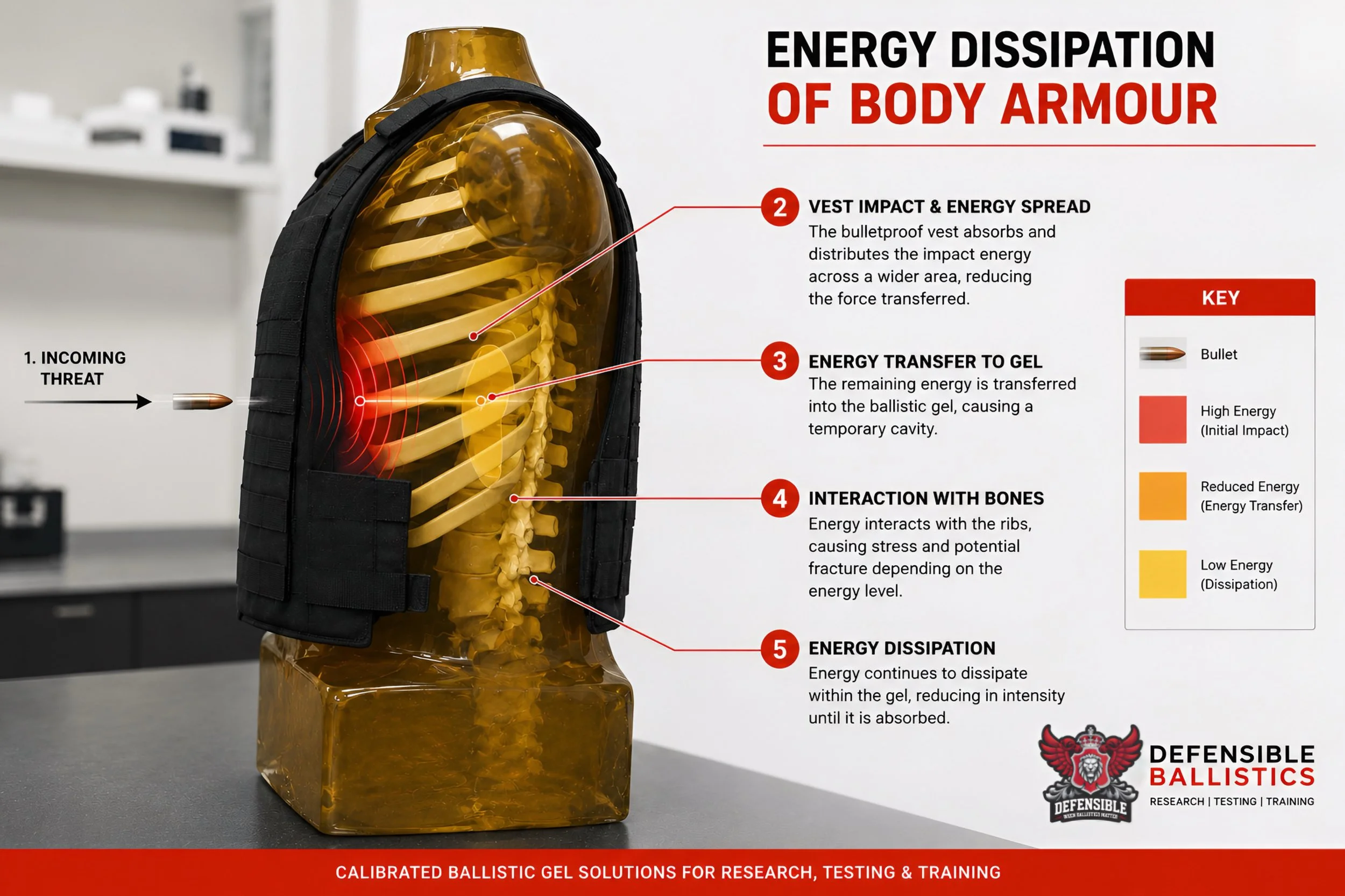
Its purpose is to absorb, spread and dissipate energy before that energy reaches the body. Even when a projectile is stopped by armour, force can still transfer through the protective material and into the soft tissue and skeletal structures beneath.
This is where calibrated ballistic gel becomes an essential testing medium.
At Defensible Ballistics, our ballistic gel solutions support defence, forensic and research applications where understanding energy dissipation is critical.
What is energy dissipation?
Energy dissipation is the process of reducing, spreading or absorbing energy during an impact.
When a projectile strikes body armour, the armour system is designed to manage that energy. Some of the energy may be absorbed by the armour. Some may be spread across a wider area. Some may still transfer into the backing material behind the armour.
In body armour testing, understanding energy dissipation is important because stopping the projectile is only part of the picture.
The key question is:
How much force still reaches the body beneath the armour?
What happens when a projectile impacts armour?
When a projectile impacts body armour, several things can happen very quickly.
The armour may deform, compress, stretch or spread the force across a larger area. The projectile may be slowed, stopped, deformed or captured by the armour material.
Behind the armour, any remaining force may transfer into the backing medium. In a real-world situation, this would be the body. In controlled testing, ballistic gel can be used as a soft-tissue simulant to help visualise and compare the effect.
A typical impact may involve:
Projectile impact
Armour deformation
Force spreading across the vest or plate
Energy transfer into the backing medium
Temporary cavity formation
Blunt force effect
Interaction with simulated tissue and bone structures
Why stopping the projectile is not the whole story
A protective system may stop a projectile but still transfer significant force into the body.
This transferred force can contribute to blunt force trauma, bruising, tissue damage or skeletal injury depending on the impact, armour system and conditions.
This is why body armour testing often considers more than penetration alone.
Useful observations may include:
Whether the projectile was stopped
How much the armour deformed
How much force transferred through the armour
Whether the backing medium was disrupted
Whether a temporary cavity formed
Whether synthetic bone structures were affected
How different armour materials compare
Ballistic gel helps make these effects easier to see and document.
Why ballistic gel is useful for body armour testing
Ballistic gel provides a controlled soft-tissue simulant behind the armour system.
When used as a backing material, gel can help researchers and engineers observe how energy is transferred after impact. It can show deformation, cavity formation and the effect of force on the simulated tissue behind the armour.
Ballistic gel can help visualise:
Energy transfer through armour systems
Backface deformation
Blunt force effects
Temporary cavity formation behind armour
Interaction with soft tissue simulants
Interaction with synthetic bone structures
Differences between armour materials
Differences between armour configurations
Backface deformation
Backface deformation refers to the inward deformation of armour after impact.
Even if the projectile does not pass through the armour, the rear surface of the armour may move into the backing material. This can transfer force into the body or test medium behind it.
Ballistic gel can help demonstrate the effect of backface deformation by showing how the gel responds behind the armour.
This can be useful for comparing:
Soft armour systems
Hard armour plates
Layered armour designs
Different backing materials
Different impact locations
Different projectile types
Different armour configurations
Blunt force trauma simulation
Blunt force trauma can occur when force is transferred into the body without full penetration.
In armour testing, this matters because the projectile may be stopped, but the impact energy still needs to go somewhere. If too much energy is transferred through the armour, it can create a harmful blunt force effect.
Ballistic gel helps provide a visible backing medium for studying this effect.
Depending on the test setup, gel may show:
Local compression
Internal disruption
Temporary cavity formation
Permanent deformation
Interaction with inserts
Impact area and spread
Force transfer patterns
Temporary cavity formation behind armour
A temporary cavity is the movement or displacement of the gel during impact.
Behind armour, this can help show how much energy is transferred through the protective system and into the soft-tissue simulant.
High-speed imaging can be especially useful because the temporary cavity may form and collapse too quickly to observe with the naked eye.
By recording the test, researchers can better understand:
How the gel moves during impact
How the armour spreads force
How much energy reaches the backing medium
Whether different armour systems produce different cavity behaviour
Synthetic bone structures and anatomical relevance
Ballistic gel can be combined with synthetic bone structures to create a more informative test model.
A simple gel block can show soft-tissue response, but adding bone structures allows researchers to observe how transferred force may interact with skeletal elements.
This can be useful when studying body armour systems because the chest contains ribs, sternum and other structures that may be affected by blunt force.
Synthetic bone structures may help demonstrate:
Rib interaction
Sternum loading
Force transfer to skeletal structures
Potential fracture mechanisms
Differences between armour configurations
How energy spreads through the gel and bone system
Why calibrated gel matters
Calibration is important because the gel is being used as a controlled comparison medium.
If the backing material is inconsistent, it becomes harder to know whether the result was caused by the armour, the projectile, the test setup or the gel itself.
Calibrated ballistic gel helps provide a more consistent baseline.
This is especially useful when comparing:
Armour materials
Armour thicknesses
Soft armour systems
Hard armour plates
Layered configurations
Different backing structures
Different test conditions
10% and 20% ballistic gel for armour testing
Different gel densities may be used depending on the purpose of the test.
10% ballistic gel is softer and commonly used for forensic/FBI-style testing, general demonstrations and soft-tissue simulation.
20% ballistic gel is firmer and commonly used for NATO-style testing or where a denser, more resistant medium is required.
For body armour and backing material tests, the correct gel density depends on the test standard, research aim and type of comparison being made.
Synthetic ballistic gel for visual analysis
Synthetic ballistic gel is particularly useful for visual analysis because it is transparent, calibrated and reusable when handled correctly.
Transparency allows the user to see the internal response of the gel after impact. This can make it easier to inspect cavity formation, displacement and interaction with inserts.
Synthetic ballistic gel may be useful for:
Backing material demonstrations
Energy transfer visualisation
Armour comparison
Photography and video
High-speed imaging
Research and product development
Repeated test programmes
Body armour material comparison
Different armour materials can behave very differently.
Some materials may spread force across a wider area. Others may concentrate deformation in a smaller region. Some systems may be better at reducing backface deformation, while others may perform differently depending on projectile type and impact location.
Ballistic gel can help compare:
Soft armour
Hard armour
Composite panels
Ceramic plates
Polyethylene systems
Layered materials
Experimental materials
Different carrier or vest configurations
The ability to visualise the backing response helps make comparisons clearer.
Vehicle and protective structure testing
The same principles can also apply to vehicle protection and protective structures.
When a force or fragment is stopped by a protective layer, the backing material can help show how much energy still transfers through the system. Ballistic gel may be used as part of a wider test setup to help visualise that effect.
This can support research into:
Vehicle floor protection
Protective panels
Blast-resistant materials
Occupant protection systems
Fragment mitigation
Layered protective structures
High-speed analysis
High-speed imaging can provide valuable insight into body armour testing.
Some effects happen too quickly to see clearly during the test. A high-speed camera can capture temporary cavity formation, armour movement, gel displacement and the timing of energy transfer.
This can help researchers better understand:
When the armour deforms
How force spreads
How the backing material moves
How quickly the cavity forms
How the gel recovers after impact
How different armour systems compare
High-speed analysis is especially useful when studying energy dissipation.
Training and demonstration
Ballistic gel can also be useful for training and demonstration.
For instructors, it provides a visual way to explain what happens behind armour after impact. This can help trainees understand why armour design, fit, material choice and energy dissipation all matter.
Gel-based demonstrations can support:
Defence training
Forensic education
Research presentations
Product demonstrations
Armour development briefings
Safety awareness
Medical response training
The visual nature of gel makes complex energy transfer easier to understand.
Medical and trauma research applications
Body armour testing can also connect with medical and trauma research.
Understanding how force transfers through armour may help inform injury mechanism research, trauma training and medical response planning.
Gel systems with synthetic bone structures may be useful for demonstrating how energy interacts with soft tissue and skeletal structures in controlled conditions.
Common mistake: assuming stopped means safe
A common mistake is assuming that if a projectile is stopped, the body beneath is unaffected.
Stopping penetration is essential, but the remaining force can still matter. Backface deformation and blunt force trauma are important parts of armour performance.
Ballistic gel helps show what happens behind the armour.
Common mistake: ignoring armour fit and placement
Armour performance can be affected by how the system is positioned and supported.
A plate or vest may behave differently depending on fit, backing, angle and impact location. In controlled testing, these variables should be recorded and kept consistent wherever possible.
Common mistake: comparing different test setups directly
Results from different setups should not be compared without understanding the variables.
Gel density, armour type, projectile type, distance, impact angle, backing support and environmental conditions can all affect the result.
For meaningful comparison, keep the setup controlled and document the conditions clearly.
Common mistake: treating gel as a complete human body substitute
Ballistic gel is a soft-tissue simulant, not a complete human body substitute.
Even when synthetic bone structures are added, the model remains a controlled test system rather than a perfect reproduction of the human body. Results should be understood as controlled observations that help support research, comparison and demonstration.
Summary
Modern body armour is designed to absorb, spread and dissipate energy before it reaches the body.
Ballistic gel provides a controlled and visual way to study what happens behind armour after impact. It can help researchers and engineers examine energy transfer, backface deformation, blunt force trauma, temporary cavity formation and interaction with synthetic bone structures.
By combining calibrated ballistic gel, anatomical inserts and high-speed analysis, it becomes possible to better understand how protective equipment performs in realistic testing scenarios.
At Defensible Ballistics, our ballistic gel solutions support defence, forensic and research applications where understanding energy dissipation is critical.
Explore ballistic gel for armour testing
Defensible Ballistics supplies calibrated synthetic ballistic gel, natural ballistic gel, ballistic soap, gel chips, moulds and anatomical simulation products for testing, training, research and product development.
Browse the product range to choose the right testing medium for your application.